
Materials

Reaction bonded silicon carbide:
for the heaviest abrasion in large shapes

InVinCer RB from Blasch, dense silicon carbide filled with silicon, for liners, elbows, nozzles and cones in severe wear.

Slurry, catalyst and coarse solids that cut through steel in months.
A dense silicon carbide that stays in the line for a campaign.
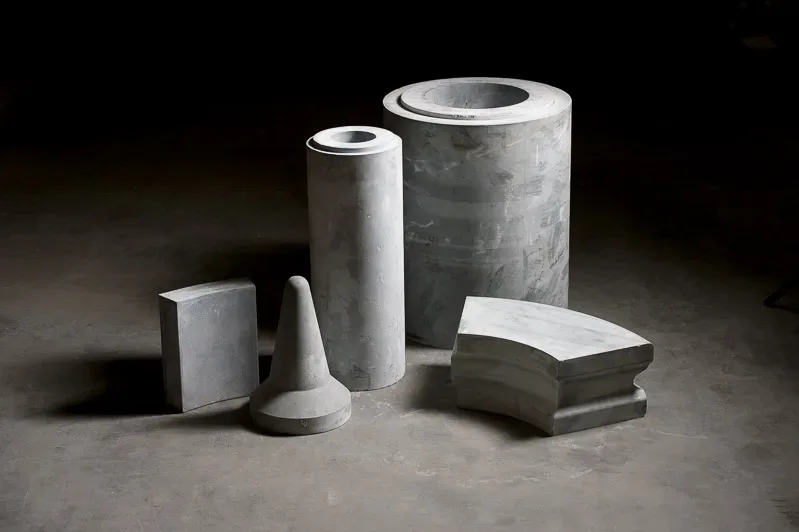
Silicon carbide shapes
In short

Reaction bonded silicon carbide is used for large wear parts in severe abrasion: cyclone and hydrocyclone liners, lined elbows and spools, nozzles, cones, sleeves and pump components that see sliding abrasion from heavy slurries or the impact of coarse particles. It is dense, practically free of open porosity and much stronger than refractory silicon carbide grades. Blasch InVinCer RB loses 1.0 cc in the ASTM C704 abrasion test and has a modulus of rupture of 37,700 psi.

What reaction bonded silicon carbide is

Reaction bonded silicon carbide, also called RBSC or SiSiC, is made from silicon carbide and carbon that are shaped and then infiltrated with molten silicon. The silicon reacts with the carbon to form new silicon carbide, which bonds the grains, and fills the remaining pores.

The result is a dense body of silicon carbide with a share of free silicon. InVinCer RB from Blasch is 86% SiC and 14% Si, with an apparent porosity below 0.1%.

Blasch casts InVinCer RB net shape, including cones, sleeves and more complex engineered pieces for raw material processing. How the Blasch process works

InVinCer RB key properties

Values from the Blasch InVinCer RB product information sheet.

Property InVinCer RB
Composition 86% SiC, 14% Si
Apparent porosity under 0.1%
Modulus of rupture, room temperature 37,700 psi (260 MPa)
Erosion, ASTM C704 1.0 cc loss
Thermal conductivity 312 BTU·in/hr·ft²·°F

Among the Blasch silicon carbide grades, InVinCer RB has the lowest volume loss in the ASTM C704 abrasion test and by far the highest strength. That is what lets a liner take the direct impingement of light particles as well as the impact and sliding abrasion of heavy, solids laden slurries.

The limit: the free silicon melts at about 1,414 °C, so reaction bonded silicon carbide is a wear material for moderate temperatures. For very hot service, use sintered silicon carbide or a refractory grade.

Dense where it counts

A wear liner fails at its weakest grain, and in reaction bonded silicon carbide there is no open pore for the abrasive to start from.

What it does in real plants

FCC catalyst transfer line, European refinery, 200,000 barrels per day: catalyst at 690 °C with temperature swings. Steel elbows had failed within days. InVinCer RB lined elbows ran up to 12 months, more than ten times as long, and about 13 elbows in the line were converted. FCCU catalyst line case study

Lithium battery manufacturer, US Midwest: highly corrosive conveyed material. Stainless pipe and elbows had to be replaced every few months. Elbows and spools lined with InVinCer RB in 304 stainless housings with custom flanges have run for more than a year. Battery production case study

Fluidized bed nozzles: InVinCer RB arrowhead nozzles in a fluidized bed improved product life fivefold over metallic components. Arrowhead nozzle case study

Blasch parts made from InVinCer RB

Large shapes for the most abrasive service in the plant.

CeraLine elbows and spools

One piece cast liners in steel or stainless housings, with flanges to fit.

Ceramic lined elbows

Hydrocyclone liners

Cones, apexes, spigots and inlet scrolls as one piece assemblies.

Hydrocyclone liners

Pump components

Suction side, impeller and volute linings for slurry pumps.

Ceramic pump components

Micronizer liners

Wear liners for mills that grind abrasive powders to fine particle sizes.

Micronizer liners

More InVinCer RB parts

InVinCer RB is also used for FGD and spray nozzles, in line chokes and reducers, boiler tube ferrules and fluidized bed nozzles. Most of these parts go to mining and mineral processing, battery materials manufacturing and power generation. For large shapes with more thermal cycling, compare nitride bonded silicon carbide.

Sources

InVinCer RB values: Blasch InVinCer RB product information sheet. Plant results: Blasch CeraLine case studies (FCCU catalyst line, lithium battery production) and the InVinCer arrowhead nozzle use case. Process and melting point of silicon: W. D. Kingery, H. K. Bowen, D. R. Uhlmann, Introduction to Ceramics, 2nd ed., Wiley, 1976; CRC Handbook of Chemistry and Physics.

Frequently asked

Questions about reaction bonded silicon carbide

What is the difference between RBSC and SiSiC?

None. Both names describe the same material: silicon carbide bonded and densified by infiltrated silicon.

What temperature can reaction bonded silicon carbide take?

Its free silicon melts at about 1,414 °C, so it is used well below that. For hotter service, sintered silicon carbide has no free silicon.

Is reaction bonded silicon carbide better than alumina?

In heavy abrasion, the Blasch reaction bonded grade usually lasts longer and is tougher against particle impact; alumina is chosen for oxidizing heat and molten metal.

Can it replace a worn steel elbow without changing the line?

Yes. Blasch designs the liner and housing to your face to face dimensions and flanges, so the lined part drops into the existing line.

Steel that wears through
between turnarounds?

Send the line or part dimensions, the medium and the failure history. A Blasch engineer designs the InVinCer RB liner to fit.

Talk to an engineer Call