Materials

High temperature ceramics:
choosing the material by heat, medium and wear

Over 15 engineered ceramic materials from Blasch, from alumina and mullite to seven silicon carbide grades, and how to pick one.

The right material is the one that fails last in your conditions.
Three questions narrow it down: how hot, what medium, which kind of wear.

White cast alumina ring and bars next to a beaker of alumina grain
In short

The right high temperature ceramic follows from three conditions: the temperature profile including how fast it changes, the medium the part touches, and the kind of wear it sees. Alumina, alumina zirconia and mullite bonded grades cover the highest temperatures and metal melts, silicon carbide grades cover abrasion and erosion, and oxide bonded silicon carbide, aluminum titanate and calcium silicate cover molten aluminum. Blasch casts over 15 of these engineered ceramic materials net shape and chooses the grade with you for one specific part.

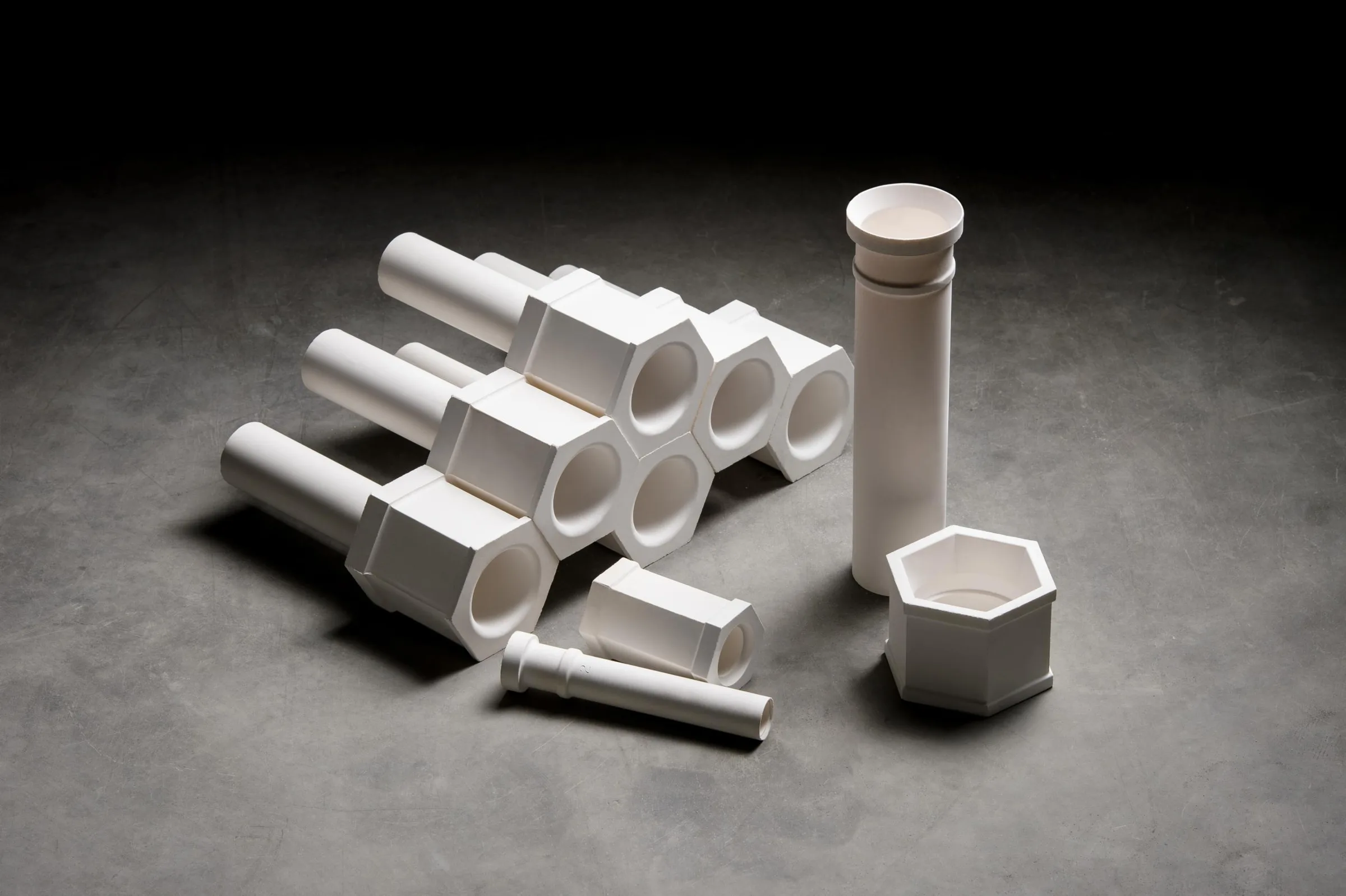
Hex head ceramic ferrules and tube shapes

Why the material is a design decision

A ceramic part rarely fails because it is not hard enough or not heat resistant enough on paper. It fails because the conditions combine: a hot face and a cold back, a melt that wets it, particles that hit it at an angle, a cycle that repeats every shift.

That is why Blasch does not sell a material and then look for a use. The engineer starts with the failure you already know, then picks the material and designs the shape around it, from your dimensions. A drawing helps but is not required.

Blasch has developed more than a hundred mixes in its own lab in Albany, New York, and tests them in house for thermal shock, abrasion to ASTM C704, acid resistance, creep and strength. How the Blasch process works

Choose by temperature

Look at the peak temperature and at how often and how fast it changes. Values are Blasch ratings for specific grades.

Temperature profile Materials to consider
Up to about 1,000 °C, frequent cycling Cordierite, fused silica, silicon nitride
Hot metal handling, fast heat-up Fused silica (up to 1,649 °C, no repeated cycling above 1,000 °C), aluminum titanate
Wear at moderate temperature Reaction bonded silicon carbide (free silicon melts at about 1,414 °C)
Around 1,600 °C with load Sintered silicon carbide (application temperature 1,600 °C), mullite bonded alumina
Up to 1,760 °C in metal melting High alumina and alumina zirconia crucible grades

Low temperature, many cycles: cordierite is stable up to 1,000 °C and a low cost choice for kiln furniture and burner parts. Fused silica has near zero expansion, but loses that advantage if it cycles above 1,000 °C.

High temperature with load: mullite and mullite bonded alumina hold their shape where firebrick creeps; alumina crucible grades run up to 3,200 °F (1,760 °C).

The condition you forgot

Most ceramic parts that fail early were chosen for the temperature on the data sheet, and broken by the temperature change, the melt or the particle nobody wrote down.

Choose by medium

Molten aluminum and nonferrous alloys: the part has to stay non wetting. Oxide bonded silicon carbide (OXYTRON) and its newer generation OXYTRON 015XDII need no protective layer in aluminum. Aluminum titanate is the riser tube material, calcium silicate the insulating option, and silicon nitride the tough one for heater tubes and sheaths.

Superalloys, steel and stainless melts: high alumina and alumina zirconia grades. Where the melt is especially aggressive, zirconia and alumina zirconia resist it longer.

Acids, bases and hot corrosive gas: sintered silicon carbide has no free silicon or oxide bond to attack; alumina and mullite are stable in many furnace atmospheres.

Choose by kind of wear

Sliding abrasion from slurry and fine solids: reaction bonded silicon carbide has the lowest ASTM C704 loss of the Blasch silicon carbides, 1.0 cc.

Erosion with thermal stress: alumina bonded silicon carbide (ALTRON) and nitride bonded silicon carbide (NITRON) combine wear resistance with thermal shock tolerance.

Impact and thin edges: tungsten carbide and zirconia are tougher than any silicon carbide and take the hit a dense ceramic would not survive.

Load at temperature, little wear: recrystallized silicon carbide carries kiln loads without sagging.

The seven silicon carbide grades are compared side by side on silicon carbide ceramics.

From material to part

The material is half of the answer. The other half is the shape and how the part is built in.

Net shape casting

Complex shapes from 1 oz to 2 tons, cast to about 0.5% tolerance without machining.

Large and complex shapes

Modeling and testing

FEA and CFD before the first part, in house tests for thermal shock and abrasion.

CFD, FEA and testing

Custom engineered shapes

A part designed for your equipment from its dimensions, in the grade that fits the failure.

Custom ceramic shapes

Where the materials work

Blasch materials go into refining and chemical plants, molten metal operations, power generation, mining and industrial process heating. The parts made from each grade are listed on its material page, and all parts by product group are under engineered ceramic products.

Sources

Blasch ratings and test values: Blasch material pages and product information sheets for each grade; Blasch company presentation (mixes, in house testing); Procaster-Z (087) data sheet. Test method: ASTM C704, Standard Test Method for Abrasion Resistance of Refractory Materials at Room Temperature. General material behavior: W. D. Kingery, H. K. Bowen, D. R. Uhlmann, Introduction to Ceramics, 2nd ed., Wiley, 1976.

Frequently asked

Questions about high temperature ceramics

Which ceramic is the most heat resistant?

It depends on load and cycling. Among Blasch grades, high alumina crucibles run up to 1,760 °C and sintered silicon carbide holds its strength to about 1,600 °C.

Can ceramics withstand rapid temperature changes?

Some can. Fused silica, cordierite, aluminum titanate and the porous bonded silicon carbides tolerate thermal shock far better than dense alumina.

Which ceramic resists molten aluminum?

Non wetting grades: oxide bonded silicon carbide, OXYTRON 015XDII, aluminum titanate, calcium silicate and silicon nitride.

Do I need to know the material before I ask?

No. Describe the part, the conditions and how it fails today. A Blasch engineer proposes the material and the design.

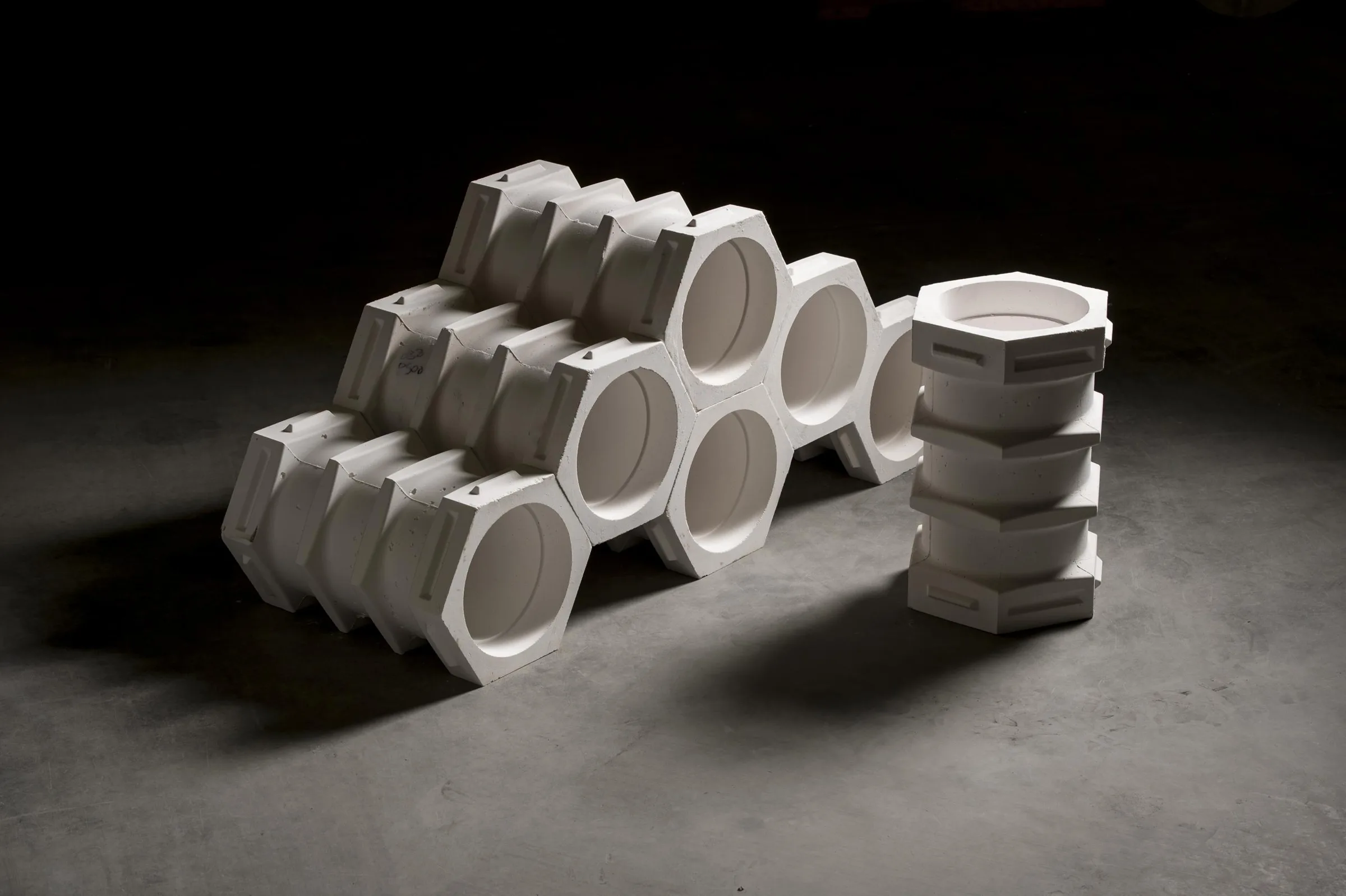
Stacked hexagonal cast ceramic blocks with round openings and interlocking tabs

Not sure which material
fits your part?

Send the dimensions, the temperature profile, the medium and the failure history. A Blasch engineer recommends the grade and designs the part.

Talk to an engineer Call