Materials

Aluminum titanate:
the riser tube material molten aluminum does not wet

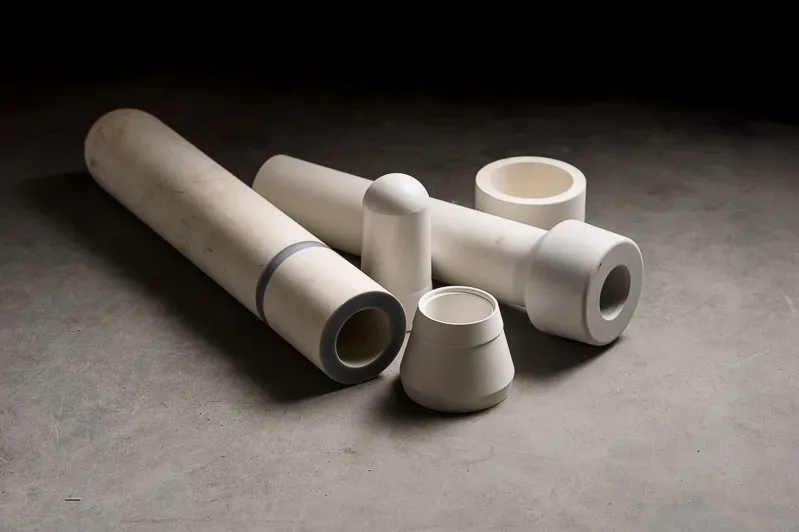
AlTech aluminum titanate from Blasch for riser tubes, stalk tubes and metering parts in aluminum die casting.

A riser tube sits in the melt for every shot and has to stay clean, tight and whole.
AlTech aluminum titanate is built for that cycle.

Aluminum titanate riser tube parts
In short

Aluminum titanate is used for riser tubes because molten aluminum alloys do not wet it, it is gas tight, and its thermal expansion is very low, so the tube does not pick up metal, does not leak air into the casting and does not crack when it moves between furnace and air. Blasch AlTech aluminum titanate riser tubes, stalk tubes and sprue bushings last longer and run more reliably than cast iron, calcium silicate or fused silica, and cut the freeze-offs common with iron tubes.

Aluminum titanate riser tube parts

What aluminum titanate is

Aluminum titanate, Al2TiO5, is an oxide ceramic made from alumina and titania. Its crystals expand very differently along different axes, and the fine network of microcracks that results lets the part take up thermal expansion internally. The body as a whole barely grows.

That gives aluminum titanate extreme thermal shock resistance. The trade-off is lower strength than dense ceramics, so it suits tubes and fittings in molten metal rather than parts under heavy mechanical load.

AlTech is the Blasch aluminum titanate, cast net shape in Albany, New York. How the Blasch process works

Why the tube stays clean

Aluminum that cannot wet the tube cannot build up on it, and a tube without buildup keeps its bore, its fill time and its seal from the first shot to the last.

Why aluminum titanate is used for riser tubes

No wetting: AlTech resists wetting by aluminum alloys completely. Oxide and metal buildup inside the tube stays low, so the bore and the flow rate stay as designed.

Gas tight: the material is impermeable to gas. In low pressure die casting, the furnace pressure pushes metal up the tube; a porous tube would let gas through the wall into the metal.

Very low expansion: the tube survives the temperature change between the holding furnace and the air during changeouts without cracking.

Fewer freeze-offs: compared with iron tubes, ceramic riser tubes reduce freeze-offs, which raises throughput.

Every Blasch riser and stalk tube is leak-down tested, and tubes can be supplied with gasketing and ceramic foam filters as a complete assembly.

How it compares with the alternatives

Cast iron: is wetted by aluminum, needs a protective layer on the surface and tends to freeze off. Calcium silicate: non wetting and insulating, but with a shorter service life in this duty. Fused silica: low expansion, but also a shorter service life in riser tubes. Blasch AlTech tubes deliver considerably longer service life and higher reliability than all three.

Sources

Blasch values and comparisons: Blasch AlTech aluminum titanate material page and riser tube product page; Blasch nonferrous product overview. Crystal structure, microcracking and low expansion of aluminum titanate: W. D. Kingery, H. K. Bowen, D. R. Uhlmann, Introduction to Ceramics, 2nd ed., Wiley, 1976.

Blasch parts made from aluminum titanate

Parts for low pressure die casting and aluminum handling.

Riser and stalk tubes

Leak-down tested tubes for low pressure die casting, with gaskets and filters on request.

Riser tubes

Stopper rods and metering pins

Flow control parts that seal and do not pick up aluminum.

Stopper rods and metering pins

Launders and tundishes

Multiuse launders and tundishes for aluminum transfer.

Launders and tundishes

More aluminum titanate parts

AlTech is also used for fill tubes, breaking spouts, thimbles and dosing tubes in molten metal plants. For other non wetting options in aluminum, compare calcium silicate and OXYTRON 015XDII.

Frequently asked

Questions about aluminum titanate

Does aluminum titanate need a coating in molten aluminum?

No. It resists wetting by aluminum alloys on its own, so no protective layer is needed, unlike cast iron tubes.

How long does an aluminum titanate riser tube last?

That depends on alloy, temperature and handling. Blasch AlTech tubes last considerably longer than cast iron, calcium silicate or fused silica tubes in the same service.

Can you supply complete tube assemblies?

Yes. Tubes come leak-down tested and can be delivered with gasketing and ceramic foam filters fitted.

What lead times can I expect?

Short lead times are one of the reasons plants switch to AlTech. Ask for the current lead time for your tube size.

Aluminum titanate riser tube parts

Riser tubes that freeze off
or leak too soon?

Send the tube dimensions, the alloy and the machine. A Blasch engineer quotes the AlTech tube or assembly.

Talk to an engineer Call