
Materials

Sintered silicon carbide:
worth its cost where heat and chemistry rule out the rest

ULTRON sintered silicon carbide from Blasch for acids, bases and temperatures up to about 1,600 °C.

Pure silicon carbide, no free silicon, no oxide bond to give way.
For parts where every other grade has a weak spot.
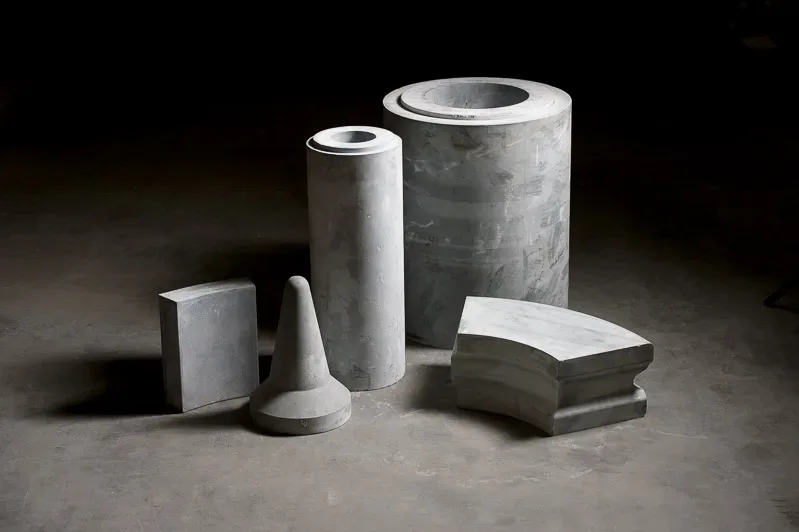
Silicon carbide shapes
In short

Sintered silicon carbide is worth its higher cost where a part combines wear with temperatures above the limit of reaction bonded silicon carbide, or with strong acids and bases that attack free silicon or an oxide bond. Blasch ULTRON is sintered at 2,200 °C, has an open porosity below 0.1%, a bending strength of 480 to 600 MPa and keeps that strength nearly constant up to about 1,600 °C. For plain abrasion at moderate temperature, reaction bonded silicon carbide does the same job for less.

What sintered silicon carbide is

Sintered silicon carbide (SSiC) is made from very fine silicon carbide powder with sintering additives. It is shaped like other ceramics and then sintered at 2,200 °C in an inert gas atmosphere, so the SiC grains bond directly to each other.

Unlike bonded grades, there is no second phase between the grains that could melt, oxidize or dissolve. That is where its temperature and chemical resistance come from.

ULTRON is the sintered grade in the Blasch silicon carbide family. Compare all silicon carbide grades

ULTRON key properties

Values from the Blasch ULTRON product information sheet.

Property ULTRON
Application temperature 1,600 °C
Density over 3.08 g/cm³
Open porosity under 0.1%
Bending strength 480 to 600 MPa
Modulus of elasticity 420 to 450 GPa
Thermal conductivity 74 W/m·K
Coefficient of thermal expansion 4.5 x 10⁻⁶ /K
Acid and alkali resistance excellent

The strength stays nearly constant up to very high temperatures, about 1,600 °C, with no degradation over time. Corrosion resistance in acidic and basic media is maintained up to high temperatures as well.

Nothing between the grains

Every bonded grade is only as strong as what sits between its grains, and sintered silicon carbide has nothing there to give way.

Where sintered silicon carbide is worth its cost

Hot wear: above the range where the free silicon of reaction bonded silicon carbide limits its use, for example in high temperature burner nozzles and kiln furniture for very high firing temperatures.

Strong acids and bases: seals and liners in chemical service, such as slip ring seals in chemical pumps and bearing bushes, where the medium would attack free silicon or an oxide bond.

Wear plus corrosion: cyclone liners and valve parts that see abrasive slurry and an aggressive liquid at the same time.

Where it is not worth it

For abrasion at ambient or moderate temperature with neutral media, reaction bonded or alumina bonded silicon carbide wears comparably for less money. For large shapes with frequent temperature swings, nitride bonded silicon carbide is the more forgiving choice.

Blasch parts made from ULTRON

Parts for hot, corrosive and abrasive duty.

Burner nozzles and flare tips

High temperature nozzles that keep their shape in the flame.

Burner nozzles

Reactor vessel linings and bubble caps

Linings, bubble caps and tuyeres for hot, corrosive reactors.

Reactor vessel linings

Abrasion resistant valves

Valve components for slurry with aggressive liquids.

Ceramic valve components

Cyclone and hydrocyclone liners

Liners where wear and chemical attack meet in the same vessel.

Hydrocyclone liners

Where ULTRON works

ULTRON is one of the liner grades for CeraLine lined pipe and elbows and goes to chemical processing, mining and power generation. For molten aluminum, the non wetting oxide bonded silicon carbide is usually the better match.

Sources

ULTRON values and uses: Blasch ULTRON sintered silicon carbide product information sheet and material page; Blasch CeraLine presentation. Sintering of silicon carbide: W. D. Kingery, H. K. Bowen, D. R. Uhlmann, Introduction to Ceramics, 2nd ed., Wiley, 1976.

Frequently asked

Questions about sintered silicon carbide

What are the downsides of sintered silicon carbide?

Higher cost than bonded grades and, like every dense ceramic, brittleness under impact. For plain wear at moderate temperature it is often more than you need.

Sintered or reaction bonded silicon carbide?

Sintered for high temperature and strong acids or bases; reaction bonded for large wear parts at moderate temperature, at lower cost.

What temperature can ULTRON take?

Blasch gives an application temperature of 1,600 °C, with strength nearly constant up to that range.

What are sintered silicon carbide seals used for?

Slip ring seals in chemical pumps and bearing bushes, where the seal faces need hardness, conductivity and resistance to the pumped medium.

Hot, corrosive and abrasive
at the same time?

Send the dimensions, the medium and the temperature. A Blasch engineer checks whether ULTRON is worth it for your part, or whether a bonded grade will do.

Talk to an engineer Call