Materials

Alumina ceramic:
when purity, density and shape decide the service life

Cast alumina parts from Blasch, from 99.7% ultra high alumina to mullite bonded and zirconia toughened grades.

The same oxide makes a crucible for superalloys, a ferrule for a waste heat boiler and a liner for a cyclone.
What changes is the purity, the bond and the structure inside the part.

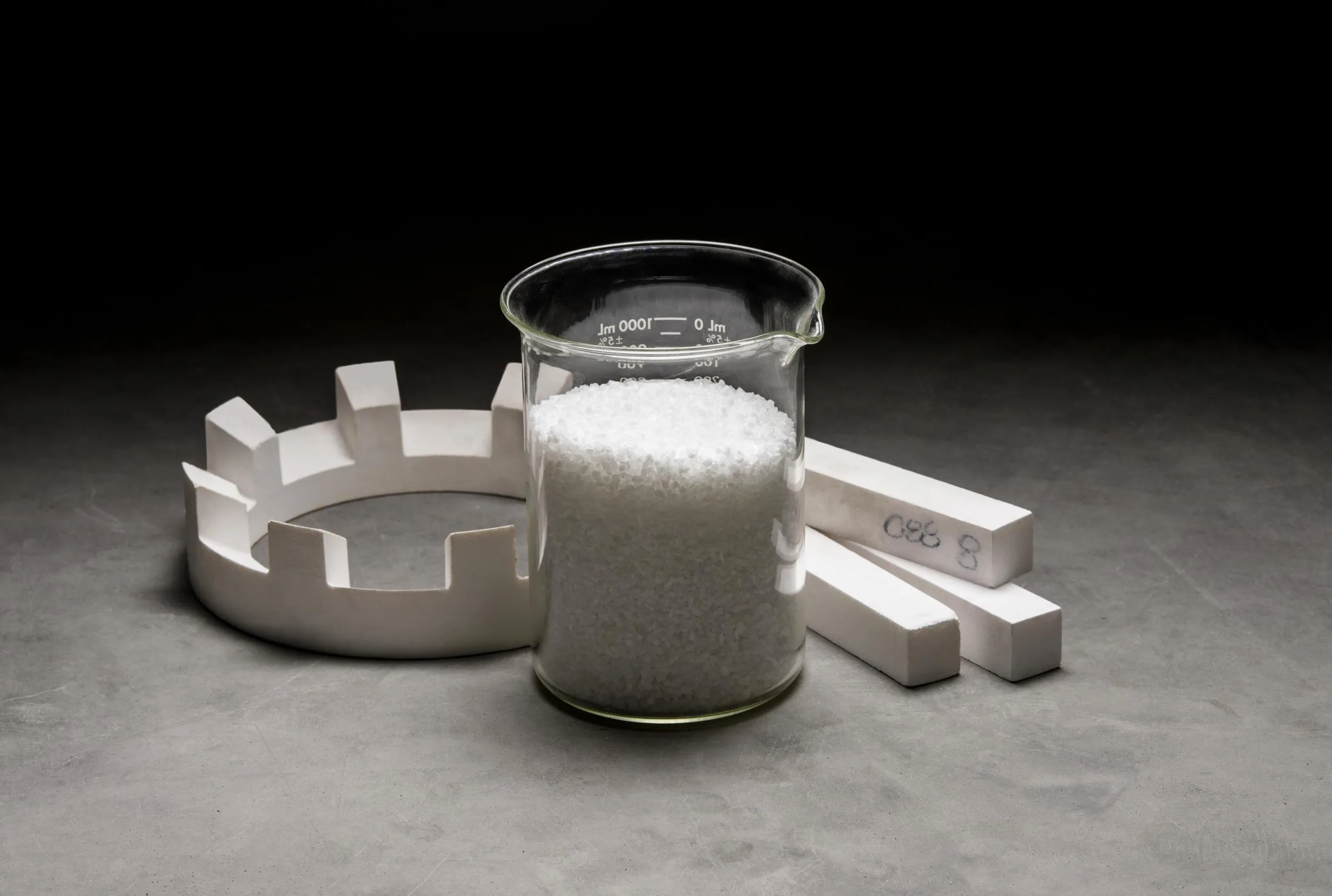
White cast alumina ring and bars next to a beaker of alumina grain
In short

Alumina ceramic, aluminum oxide (Al2O3) formed and fired into a solid part, is the right choice when a component has to resist high temperature, chemical attack or molten metal and must not conduct electricity. It reaches its limits where fast temperature swings or heavy impact dominate, and in coarse abrasive flow silicon carbide often lasts longer. Blasch casts alumina parts from about 88% to 99.8% Al2O3 and sets purity, density and porosity for the one job each part has to do.

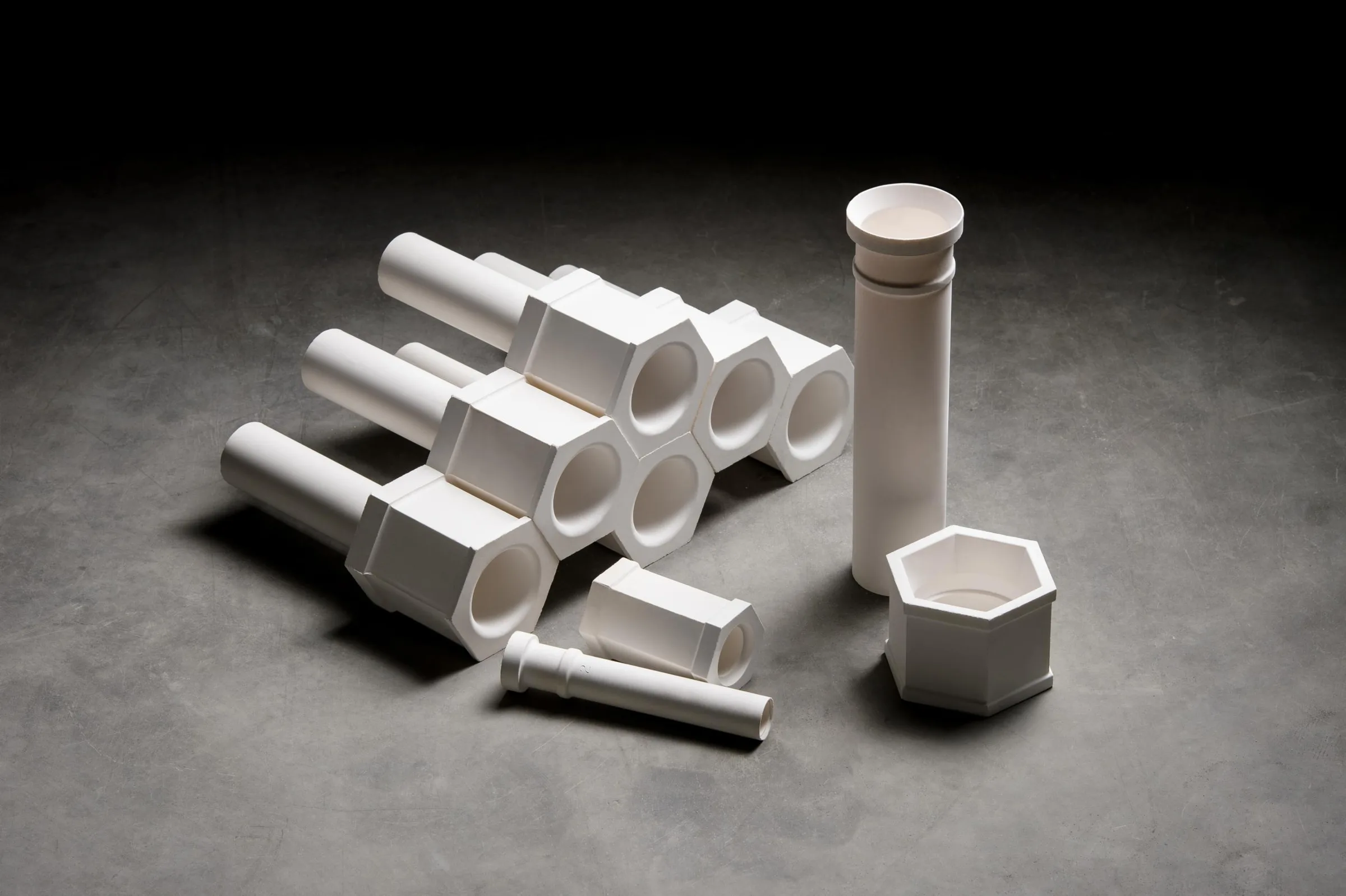
Hex head ceramic ferrules and tube shapes

What alumina ceramic is

Alumina is aluminum oxide. It is not the metal aluminum: the oxide is a ceramic, hard, chemically stable and an electrical insulator, with a melting point far above that of the metal.

An alumina ceramic part is made from alumina powder that is shaped and then fired, so the grains bond into a solid body. How pure the powder is, what holds the grains together and how much pore space remains decide how the part behaves in service.

Blasch casts these parts net shape in its own process in Albany, New York, to a linear tolerance of about 0.5%, with part weights from 1 oz to 2 tons. How the Blasch casting process works

Alumina grades and what they are for

"Alumina" covers a whole family. The grades Blasch uses differ mainly in purity and in what bonds the alumina grains.

Grade Al2O3 content Typical Blasch use
Ultra high alumina 99.7% to 99.8% Backup ram behind crucibles, ferrules in high heat flux
Dense alumina up to 99.6% Hex head ferrules, cyclone and pipe liners
High alumina (ProCaster) high alumina, by grade Crucibles for superalloy, steel and nonferrous melting
Alumina zirconia (ProCaster 087) 5% ZrO2 minimum Crucibles, tundishes and launders with the most corrosive alloys
Mullite bonded high alumina about 88% alumina and mullite Flue gas tunnels and checkerwalls in reformers and sulfur furnaces

High purity: the fewer impurities such as silica, iron oxide and alkalies, the less the alumina reacts with molten metal and slag. That is why the ALRAM backup rams behind ProCaster crucibles are 99.7% and 99.8% Al2O3.

Bond: a mullite bond keeps alumina stiff at temperature. In published tests, mullite bonded alumina kept a hot modulus of rupture of 1,700 psi, where super duty firebrick stayed under 600 psi.

Zirconia addition: a share of zirconia raises corrosion resistance in contact with aggressive melts. The Procaster-Z grade (087) carries at least 5% ZrO2 and is rated for 1,650 °C (3,000 °F) continuous and 1,760 °C (3,200 °F) intermittent.

Purity is only half the answer

Purity tells you what an alumina part resists, but its structure decides whether it survives the first fast heat-up.

When alumina is the right ceramic for wear and heat

Alumina is a good first choice in four situations.

  • High temperature with molten metal: high alumina crucibles for coreless induction furnaces run up to 3,200 °F (1,760 °C) and melt superalloys, steel, stainless, iron and nonferrous alloys.
  • Heat flux at a tube inlet: dense alumina ferrules protect the tubesheet of waste heat boilers where gas enters at furnace temperature.
  • Chemical attack: alumina is stable against many acids, gases and slags that corrode steel.
  • Electrical insulation at temperature: heating element holders and insulators rely on alumina staying an insulator.

Where alumina is not the first choice: in fast thermal cycling, dense alumina is more sensitive than silicon carbide, cordierite or fused silica. Under coarse particle impact, reaction bonded or alumina bonded silicon carbide usually wears slower. And where molten aluminum must not stick, an oxide bonded silicon carbide or aluminum titanate is the better match. Silicon carbide grades

Blasch works around the thermal shock limit through the structure of the part: particle packing, binder system and a continuous network of fine pores, 3 to 5 micron, take up stress that would crack a fully dense body. A Blasch video shows 99.7% ultra high alumina ferrules going through a thermal shock test. Watch the ultra high alumina thermal test

Blasch parts made from alumina

Each part is designed for its application from your dimensions and operating conditions.

ProCaster crucibles

High alumina crucibles for induction melting, as a replacement for zirconia crucibles in many alloys.

ProCaster crucibles

Ceramic ferrules

One and two piece ferrules from dense and ultra high alumina that protect the tubesheet.

Ferrules for waste heat boilers

ALRAM backup ram

Dry ultra high alumina ram, 99.7% and 99.8% Al2O3, behind crucibles from 5 lb to 1,000 lb.

ALRAM backup ram

Kiln furniture and pusher plates

Low mass alumina supports that carry ware through sintering and firing furnaces.

Kiln furniture

More alumina components

Dense alumina also lines hydrocyclones and cyclones, forms air heater inserts, and an ultra high alumina loop is one of the options for channel furnace linings. Alumina mullite is used for threaded sample cups for molten metal.

Plants that use these parts are mostly in molten metals and refining and chemical processing. If you are deciding between alumina and its toughened relative, see zirconia ceramics.

Not a coating, a solid part

Many searches for alumina ceramic end at sprayed alumina coatings. Blasch does not coat. The part itself is cast from alumina, so there is no layer that can chip or wear through to the steel underneath.

Sources

Material grades and Blasch values: Blasch product information sheets for ALRAM 3030 and 4041, Procaster-Z (087) and ProCaster crucibles; Blasch company presentation; Nitrogen+Syngas, July/August 2016. General properties of alumina: W. D. Kingery, H. K. Bowen, D. R. Uhlmann, Introduction to Ceramics, 2nd ed., Wiley, 1976.

Frequently asked

Questions about alumina ceramic

Is alumina the same as aluminum?

No. Alumina is aluminum oxide, a ceramic. It does not melt or corrode like the metal and does not conduct electricity.

Is alumina ceramic brittle?

Yes, like every ceramic it breaks rather than bends. Part design with generous radii, the right wall thickness and room for expansion keeps tensile stress low.

What temperature can an alumina part take?

It depends on the grade. Blasch high alumina crucibles are used up to 3,200 °F (1,760 °C); the limit for a given part also depends on load and temperature cycling.

Does Blasch apply alumina coatings?

No. Blasch casts solid alumina parts, such as ferrules, crucibles and liners, that replace the worn part rather than covering it.

When should I choose zirconia instead of alumina?

When a part sees impact, sliding wear or an especially aggressive melt and needs more toughness than alumina offers.

White cast alumina ring and bars next to a beaker of alumina grain

Not sure which alumina grade
fits your part?

Send the dimensions, the temperature and the medium. A Blasch engineer recommends the grade and designs the part.

Talk to an engineer Call