
Materials

Silicon carbide ceramic:
seven grades, one question about the bond

How the Blasch silicon carbide grades differ, from oxide bonded OXYTRON to sintered ULTRON, and which one fits your wear.

Every silicon carbide part is mostly silicon carbide.
What holds the grains together decides where it lasts.
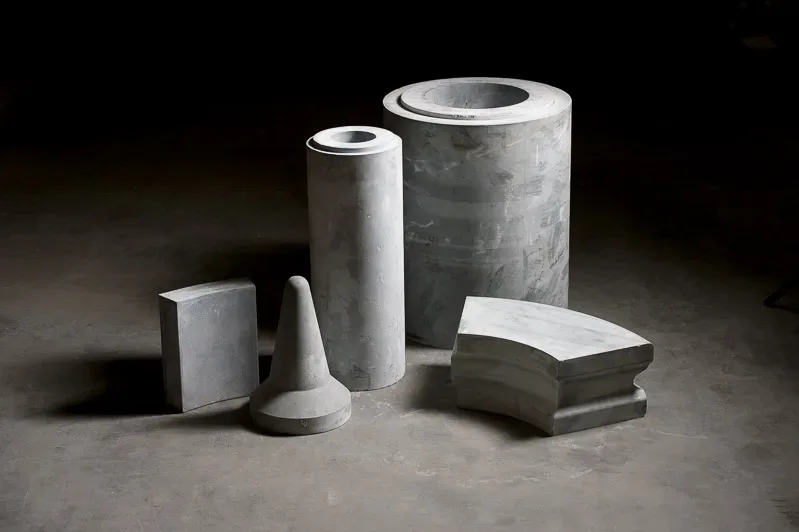
Silicon carbide shapes
In short

The right silicon carbide ceramic grade depends on the bond between the grains: reaction bonded and sintered silicon carbide are dense and resist the heaviest abrasion, alumina and nitride bonded grades combine good wear resistance with thermal shock tolerance at lower cost, and oxide bonded grades are chosen for molten aluminum because they do not wet. Recrystallized silicon carbide carries load at kiln temperatures. Blasch casts all seven grades net shape, so the choice follows the application, not the shapes a supplier can make.

What silicon carbide ceramic is

Silicon carbide (SiC) is a compound of silicon and carbon. As a ceramic it is very hard, conducts heat well and keeps its strength at high temperature, which makes it the standard material for parts that wear in hot, abrasive or chemically aggressive service.

SiC grains do not bond to each other easily. Each grade solves that differently: with a second phase such as alumina, silicon nitride or an oxide, with metallic silicon filled into the pores, or by sintering or recrystallizing the SiC grains themselves.

That bond sets porosity, strength, erosion resistance, thermal shock behavior and the upper temperature limit. Two grades with similar SiC content can behave very differently in the same line.

The seven Blasch silicon carbide grades

Values from the Blasch product information sheets. Erosion is volume loss in the ASTM C704 abrasion test, lower is better.

Grade Bond SiC Apparent porosity Modulus of rupture ASTM C704 loss
InVinCer RB reaction bonded, silicon filled 86% under 0.1% 37,700 psi (RT) 1.0 cc
ULTRON sintered n/a under 0.1% 480 to 600 MPa not stated
ALTRON alumina bonded 75% 5 to 10% 5,600 psi (RT) 1.5 cc
OXYTRON 015XDII oxide bonded, continuous SiC phase 64% 14.5% 6,261 psi (RT) 1.8 cc
InVinCer Rx recrystallized over 99% under 15% 13,800 psi (RT) 2.4 cc
NITRON nitride bonded 70% 16% 6,000 psi not stated
OXYTRON oxide bonded 67% 14% 8,000 psi (2,000 °F) not stated

Read the table as a map, not a ranking. The densest grades lose the least volume in the abrasion test, but they also cost the most and are less forgiving of a part that cracks from thermal stress.

The bond is the choice

You are not choosing silicon carbide, you are choosing what holds it together, and that decides whether the part wears out, cracks or simply stays in place.

Which grade fits which application

Heavy abrasion from coarse solids and slurry: InVinCer reaction bonded silicon carbide is dense and almost free of pores. Its free silicon limits it to lower temperatures than the bonded refractory grades.

Abrasion plus chemical attack, up to very high temperature: ULTRON sintered silicon carbide has no free silicon and keeps its strength to about 1,600 °C.

Erosion where dense ceramics crack: ALTRON alumina bonded silicon carbide approaches the abrasion resistance of dense advanced ceramics and keeps the thermal shock tolerance of a refractory grade.

Large shapes, wear and molten metal: NITRON nitride bonded silicon carbide is used for cyclone linings, spray nozzles, heater tubes and large wear shapes.

Molten aluminum and replacement of cast iron: OXYTRON oxide bonded silicon carbide does not wet in aluminum and weighs about one third of a cast iron part. Its newer generation, OXYTRON 015XDII, adds a continuous SiC phase for more erosion resistance.

Kiln furniture and load at temperature: InVinCer recrystallized silicon carbide is nearly pure SiC and carries load unsupported at high temperature without sagging.

If the part also sees fast temperature changes, say so early. The bond that resists abrasion best is not always the one that survives a cold start. When silicon carbide is not the answer at all, silicon nitride or zirconia may be.

Blasch parts made from silicon carbide

The same grades go into very different parts, each designed for its line or vessel.

CeraLine lined pipe and elbows

One piece cast liners in steel housings for pneumatic conveying and slurry.

CeraLine lined pipe

Hydrocyclone liners

Cones, apexes, spigots and inlet scrolls in one piece, 1 to 60 inches in diameter.

Cyclone and hydrocyclone liners

Air grid nozzles

ALTRON nozzles welded into FCC air grids in place of steel nozzles.

Air grid nozzles

Dust collector components

SiClone outlets, inlets and spin vanes in OXYTRON and ALTRON instead of cast iron.

Dust collector components

Where silicon carbide works

Silicon carbide parts from Blasch run in mining and mineral processing, power generation and molten metals, wherever steel, cast iron or tile wear through between two planned turnarounds.

Sources

Grade values: Blasch product information sheets for InVinCer RB, InVinCer Rx, ALTRON, NITRON, OXYTRON, OXYTRON 015XDII and ULTRON. Test method: ASTM C704, Standard Test Method for Abrasion Resistance of Refractory Materials at Room Temperature. General properties of silicon carbide: W. D. Kingery, H. K. Bowen, D. R. Uhlmann, Introduction to Ceramics, 2nd ed., Wiley, 1976.

Frequently asked

Questions about silicon carbide ceramic

Is silicon carbide a ceramic?

Yes. Silicon carbide is a non oxide ceramic, made into parts by bonding SiC grains with a second phase or by sintering them directly.

What are the downsides of silicon carbide?

It is brittle like every ceramic, dense grades cost more, and grades with free silicon or an oxide bond have a lower temperature limit than sintered SiC.

Is reaction bonded or sintered silicon carbide better?

Reaction bonded is the economical choice for large wear parts at moderate temperature. Sintered is chosen for very high temperature and strong acids or bases.

Can Blasch match an existing metal part?

Yes. Blasch can reproduce the geometry and attachment of a worn metal part in silicon carbide, from your dimensions or a sample part.

Which grade for
your wear?

Describe the medium, the particle size, the temperature and how often the part fails today. A Blasch engineer picks the grade and designs the part.

Talk to an engineer Call