Custom engineered shapes

Custom ceramic components,
cast to your dimensions

Ceramic and refractory shapes from 1 oz to 2 tons, designed by Blasch engineers when no catalog part fits.

A cast iron part that wears through, a brick wall that cracks at the mortar.
Both can become one engineered ceramic shape.
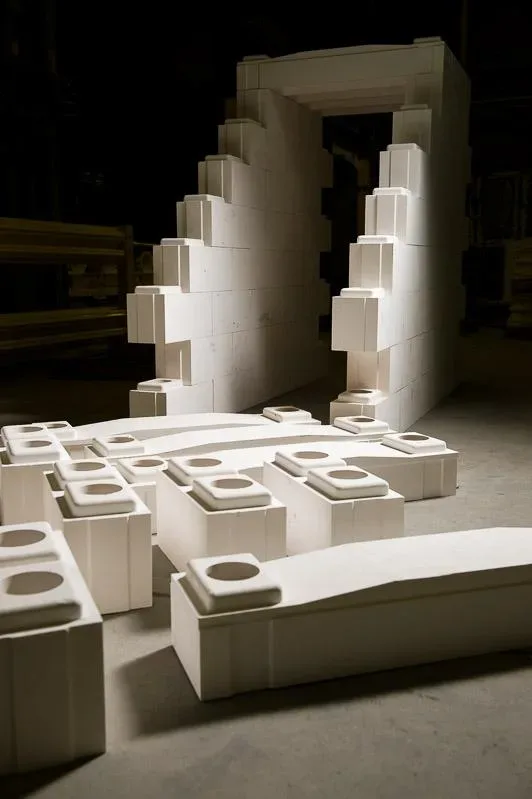
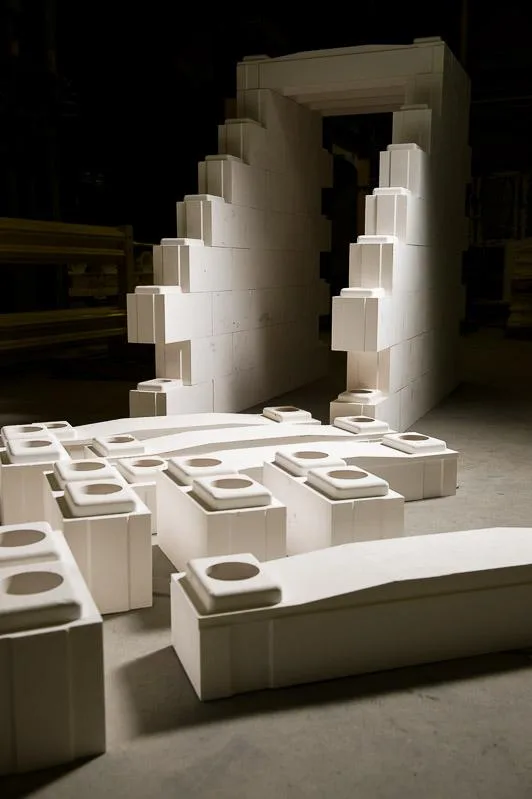
Interlocking white ceramic blocks with a doorway shaped wall behind them
In short

Blasch Precision Ceramics in Albany, New York, designs and casts custom ceramic components and refractory shapes to your dimensions, from 1 oz to 2 tons and from a single prototype to about 1,000 pieces. Parts come out of the mold near net shape, within ±0.5% on linear dimensions, so threads, bores and changing wall thickness need no machining. A drawing is not required: dimensions and operating conditions are enough for a Blasch engineer to design the part.

1 oz to 2 tonspart weights from one casting process
±0.005 in per inchlinear tolerance as cast, about 0.5%
0.06 to 6 inwall thickness, constant or changing within one part
1 to 1,000 piecesfrom a single prototype to a production run

Every batch is checked for strength, thermal shock and dimensions before it ships.

Interlocking white ceramic blocks with a doorway shaped wall behind them

What the process can form

Internal and external threads, bends, flanges, mating faces and walls that change thickness along the part are cast in, not cut in afterwards. The as-cast surface lies around 80 to 100 µm.

Porosity is set by the mix: fine, connected pores of about 3 to 5 micron give thermal shock resistance, and non-wetting additions keep molten metal from soaking into the part.

Parts can ship as assemblies, mortared, bonded or bolted, or fitted into an alloy or titanium shell, so the ceramic arrives ready to install.

Why custom pays off

A part designed for the exact place it fails replaces both the material that wore out and the joints, anchors and field work that came with it.

Where custom shapes
come from

Most custom parts start from one of four routes, depending on what you have and what fails.

From dimensions to a part

You send dimensions and conditions, the engineer chooses the grade and designs the part, with a prototype if needed.

Custom ceramic parts

Precast refractory shapes

Shapes that replace castable, plastic refractory or gunnite, fired before they reach site, with no forming or curing in the outage.

Precast refractory shapes

Large and complex shapes

Furnace blocks, liners and housings up to 2 tons that would otherwise be built from many bricks or tiles.

Large ceramic shapes

Modeled before casting

Flow, heat and stress checked with CFD and FEA, materials tested for thermal shock, abrasion and creep in the lab.

Modeling and testing

When a custom ceramic shape is the right answer

Replacing metal: high nickel castings and fabricated alloy parts are often chosen for heat or wear. A ceramic shape of the same geometry is lighter, and where nickel prices drive the cost, it is often the cheaper part.

Replacing monolithic refractory: brick and mortar, castables and gunnite fail at joints and anchors. Interlocking precast shapes stack without mortar, move independently when they heat up, and need fewer skilled masons on site.

Replacing an obsolete part: when the original supplier is gone, the geometry of the worn part is enough to cast a replacement.

A documented example

A refinery rebuilt the wall of a CO boiler with six burners from precast tongue and groove shapes. A published 2018 article reports the installation took 5 days, against about 3 weeks for the conventional build. The article on the skills gap

Related product groups

Custom work often starts next to an existing product: a special crucible or melt part, or a tubesheet that needs a shape beyond standard boiler ferrules.

Frequently asked

Questions about custom ceramic components

Do I need a drawing for a custom part?

No. Dimensions, a sketch or the worn part itself are enough. Blasch engineers create the design and the drawing for you.

What is the smallest and largest part you can cast?

Part weights range from about 1 oz to 2 tons, with walls from 0.06 to 6 inches.

How tight are the tolerances without machining?

About ±0.005 inch per inch, or 0.5% of a linear dimension, as cast and repeatable from part to part.

Can you make one prototype first?

Yes. Quantities run from one piece to about 1,000, so a prototype can be tested in your process before a series.

Two workers setting precast tunnel blocks inside a reformer furnace

Have a part nobody
can make?

Send the dimensions, the medium and the temperature. A Blasch engineer tells you which grade fits and how the part will be cast.

Talk to an engineer Call