Engineering

The Blasch process:
net shape ceramic forming since 1979

How Blasch casts complex ceramic parts close to their final shape, with very little shrinkage and no machining.

A forming process developed in Albany in 1979.
It casts ceramic parts so close to their final shape that they need no machining.

Custom engineered ceramic shapes including a perforated plate
In short

Net shape ceramic forming means making a ceramic part in its final geometry during forming, so it needs little or no machining after firing. The Blasch process does this by casting a ceramic slurry into a precise mold and setting it with a proprietary solidification step, using a binder system that leaves almost nothing to burn out. Parts shrink very little, hold a linear tolerance of about ±0.005 in (0.5%), and can carry threads, bends, tapers and changing wall thickness straight from the mold.

View into a ceramic lined pipe, smooth one piece bore

How net shape forming works

Most ceramic parts are pressed, extruded or cast oversize and then machined, because they shrink and distort as binders burn out and the part sinters.

The Blasch process starts from engineered ceramic powders mixed into a slurry. It is cast or injected into a machined mold and solidified there, so the part leaves the mold in its final shape with high green strength.

Because there is very little binder to remove, the part barely shrinks during firing. What comes out of the kiln matches the mold, every time, from the first part to the thousandth.

What the mold decides

When the shape is fixed in the mold instead of the machine shop, complex geometry costs no more to repeat than simple geometry, and that changes which parts are worth making in ceramic.

The process in numbers

Property Value
Linear tolerance without machining ±0.005 in, about 0.5%
Surface finish as cast 80 to 100 µm
Pore size 3 to 5 µm, porosity and permeability adjustable
Part weight 1 oz to 2 tons
Wall thickness 0.06 in to 6 in
Quantity per order 1 to about 1,000

What the process allows

Internal and external threads, bends, constant and transitioning wall thickness and mating surfaces can all be cast in. Parts can also be mortared into fired assemblies or delivered in an alloy or titanium shell, bonded or bolted, ready to install.

The size range runs from a matchstick to a sewer pipe, as Blasch puts it. Large and complex ceramic shapes

Why the parts handle thermal shock

Thermal shock resistance comes from three properties built in during forming: engineered particle packing, the binder system and a continuous, interconnected porosity. The fine, even pores let the structure take up stress from fast temperature changes instead of cracking.

The same process makes 99%+ alumina that is neither fine grained nor fully dense nor sintered. It keeps the chemical purity a reducing atmosphere demands without losing the thermal shock behavior, which conventional high purity alumina struggles to combine.

Materials that can be formed

High alumina, alumina mullite, mullite, fused silica, zirconia and zircon composites, aluminum titanate and silicon carbide in oxide, nitride, oxynitride, alumina and reaction bonded forms. Non-wetting additives can be included for parts in molten aluminum. Engineered ceramic materials

Where the process shows its value

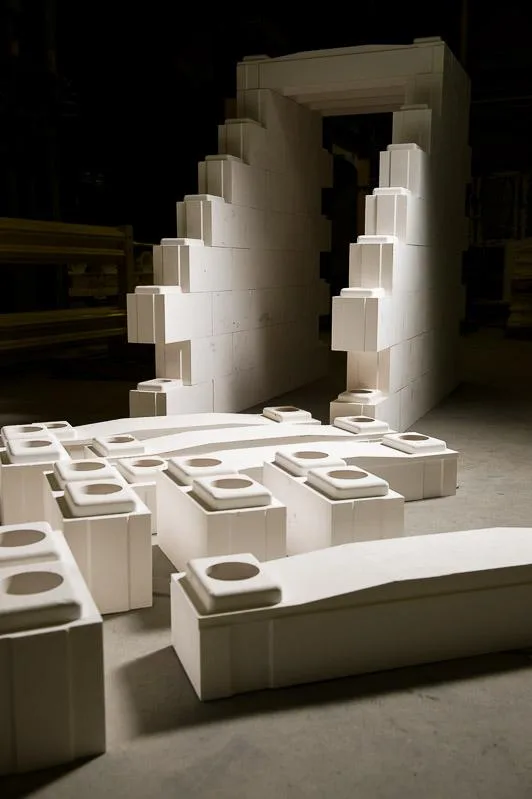
Interlocking StaBlox tunnel blocks with tongue and groove joints, hex head ferrules whose heads close into one surface at temperature, and degassing rotors with cast in threads all depend on geometry that would be costly to machine. For one-off shapes, see custom engineered ceramic shapes.

Frequently asked

Questions about the Blasch process

What is net shape ceramic forming?

Forming a ceramic part directly in its final geometry, so that little or no grinding or machining is needed after firing. Near net shape allows a small finishing allowance on selected surfaces.

Is the Blasch process the same as slip casting?

No. Both start from a slurry, but slip casting draws water into a porous mold and shrinks more on drying and firing. The Blasch process solidifies the whole casting in the mold and shrinks very little.

Is the process patented?

Blasch protects its technology with patents and with proprietary know-how that is not disclosed. The process was originally developed in 1979.

Can parts be made in small quantities?

Yes. Orders range from a single part to about a thousand, so prototypes and spare parts are made the same way as series parts.

Stacked precast ceramic blocks forming an opening

A shape you thought
could not be ceramic?

Send the part, its dimensions and where it runs. A Blasch engineer tells you whether it can be cast and in which material.

Talk to an engineer Call