Ferrules and tube inserts

Round or hex head ferrules:
which one your tubesheet needs

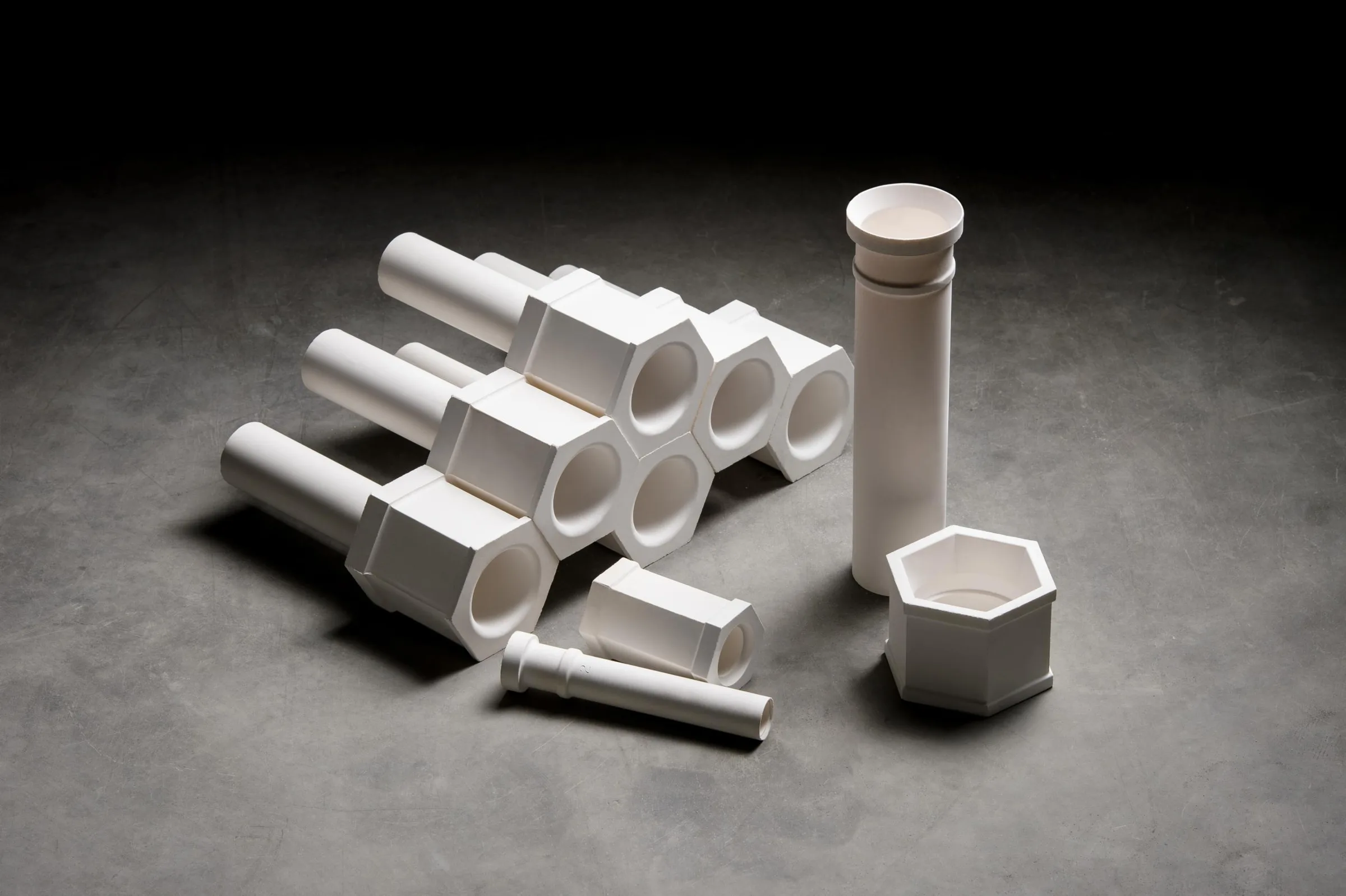
Ceramic ferrules for waste heat boiler tube inlets, with round heads for castable systems or hex heads that close on their own.

Round heads need castable to fill the gaps.
Hex heads fill them with ceramic.

Hex head ceramic ferrules for waste heat boiler tubes
In short

Use hex head ferrules when outage time and tubesheet protection matter more than the price of the parts. Their six-sided heads grow together into a closed face at operating temperature, so no castable is needed between them and no anchors sit in the hot face. Round ferrules cost less per part and suit boilers designed around a monolithic castable lining, but that castable has to be formed, cured and repaired at every turnaround.

Round heads in castable,
hex heads that close by themselves

Both designs protect the tube inlet. They differ in what fills the space between the heads.

Round ferrules

  • Round heads leave gaps that are filled with castable
  • Anchors hold the castable to the tubesheet
  • Lower part price, more work at the tubesheet
  • The castable is formed, dried and cured during the outage

Hex head ferrules

  • Six-sided heads grow together at operating temperature
  • A fiber gasket in a groove under the head seals each tube
  • Only a narrow castable ring at the edge, no anchors
  • Each ferrule floats in its tube, touched by six neighbors at most

The rule of six

A hex head ferrule answers only to the six ferrules around it, so one bad tube stays one bad tube instead of cracking the whole face.

Designs Blasch casts

Round and hex are the two families. Within each, the head, the inlet and the stem are shaped to the boiler.

01

Round heads

Single head flange, double ring, solid head with or without taper, and tapered stems with or without a ring.

02

Hex and square heads

Solid one-piece hex head, two-piece hex head, hex or square flange on a round stem, square head and mushroom style.

03

Ceramic heads on metal stems

A ceramic head on a metallic stem or tube, for boilers where the inlet sleeve is better made of alloy.

Hybrid ferrules
04

Two-piece ProLok

A hex head with a separate stem that twists and locks in place, for warped tubesheets and boilers that vibrate.

ProLok ferrules

What hex heads did in two boilers

US refinery, sulfur recovery unit, 1996. The first set of hex head ferrules went in during half a shift, where the castable system before had taken two days. The operator reported saving 2.5 to 3 days at each later outage. After 10 months in service the ferrules looked new, with no gas reaching the tubesheet. They were designed for 3 to 5 years, a life confirmed in later plants.

The same boiler showed what floating ferrules do in an upset. A liquid carryover destroyed the bottom rows. The upper ferrules survived and could be pulled by hand, and the tubesheet was fitted again within half a shift.

Sulfuric acid plant, Australia, published 2016. A waste heat boiler with 859 tubes of 70 mm by 9,000 mm and a gas inlet temperature of 951 °C was retubed within a three week outage. Setting the hex head ferrules took 67% less time than round ferrules. Read the retubing case in full.

Where round ferrules still make sense

Round ferrules remain a reasonable choice where the boiler is designed for a monolithic castable lining, temperatures are moderate and the outage plan has room for curing. Blasch casts them with precise flanges, thin walls, flared inlets and outlets and cast-in anchor grooves, so they go in faster and with less pressure drop than plain round shapes.

Service conditions

Blasch ferrules run in oxygen-enriched, acidic and hydrogen-rich reforming gas and in fluidized catalyst coolers with severe abrasion. Unlike alloy ferrules, they do not suffer metal dusting or carbon monoxide corrosion. Typical units are sulfur recovery, thermal oxidizers, waste heat boilers and catalyst coolers in refining and chemical processing, cast in high purity grades such as 99% alumina.

Frequently asked

Questions about round and hex ferrules

Are hex head ferrules more expensive?

Per part, yes, because a hex head takes more ceramic than a round one. The saving comes in the outage: no castable between the ferrules, no anchors, no curing, and less repair at the next turnaround.

Can hex heads be mortared together?

No. Each ferrule has to float in its tube. Mortar between the heads would lock them into one slab and bring back the cracking the design avoids.

Can a single ferrule be pulled for inspection?

Yes. A hex head ferrule sits loose in its tube and comes out by hand, without breaking out castable around it.

What do you need to design them?

Tube outside diameter and wall thickness, pitch, the tolerance of the tube centers, operating temperature and gas composition. A drawing is not required.

Hex head ceramic ferrules stacked in a honeycomb next to a round ferrule with a flange

Planning the next
retubing or turnaround?

Send the tube data and how long your outage window is. A Blasch engineer tells you which ferrule design fits it.

Talk to an engineer Call