Materials

Mullite ceramic:
stays straight and stays whole at furnace heat

Mullite and mullite bonded alumina from Blasch for checkerwalls, reformer tunnels and parts that see heat and load together.

A wall that carries its own weight at furnace temperature for years needs a material that does not creep.
That is where mullite works.

Mullite shapes next to a beaker of raw material
In short

Mullite ceramic resists thermal shock because it expands little when heated and keeps its strength and shape under load at high temperature, so a fast temperature change builds up less stress inside the part. Bonded to alumina, mullite holds the grains stiff: in published tests, mullite bonded alumina deflected 1.11% under creep load at 1,649 °C, where super duty firebrick deflected 7.86% at only 1,427 °C. Blasch uses mullite and mullite bonded alumina for self supporting furnace structures such as checkerwalls and reformer tunnels.

Mullite shapes next to a beaker of raw material

What mullite ceramic is

Mullite is an aluminum silicate, 3Al2O3·2SiO2. It is rare in nature and forms when alumina and silica react during firing.

As a refractory it is used in two ways: as a mullite ceramic of its own, and as the bond between alumina grains. In the second case the part is mostly alumina, but the mullite phase between the grains decides how it behaves when hot and loaded.

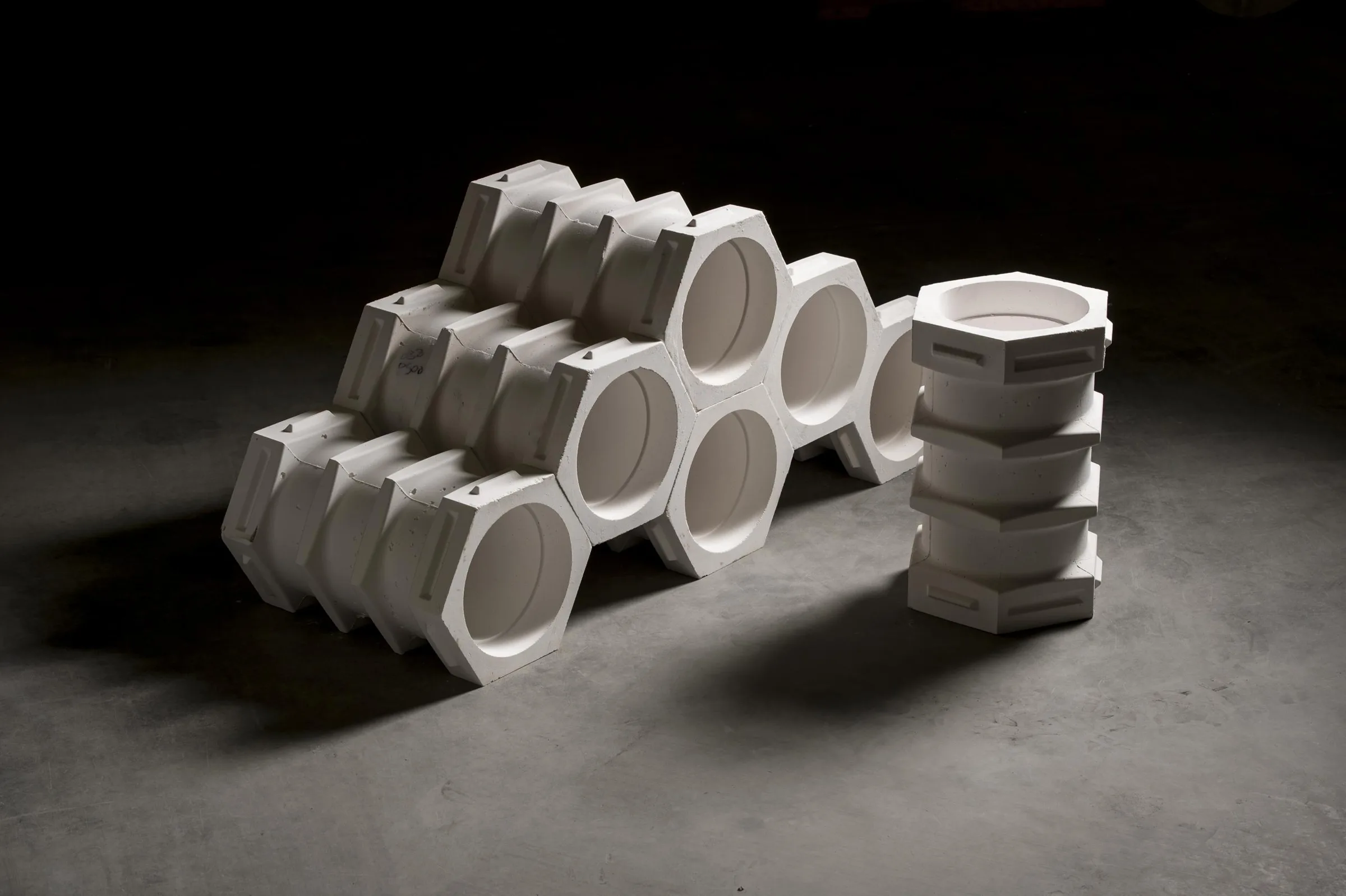
Blasch offers a range of mullite compositions and casts them net shape, including interlocking blocks with tabs and slots that stack without mortar. How the Blasch process works

Heat is not what breaks a furnace wall

A wall at constant temperature rarely fails; it fails where one side is hotter than the other, and mullite keeps that difference from turning into a crack.

Why mullite resists thermal shock

Low expansion: mullite grows less with temperature than alumina. The smaller the growth, the smaller the stress between the hot face and the cooler back of a part.

Creep resistance: mullite keeps its shape under load at temperatures where firebrick and castable slowly sag. A checkerwall or tunnel that stays straight keeps its joints closed and its openings where they were designed.

Hot strength: in the same published comparison, mullite bonded alumina kept a hot modulus of rupture of 1,700 psi, against under 600 psi for super duty brick and just under 500 psi for a high grade castable.

Chemical stability: mullite stays inert in most furnace atmospheres, including the sulfur bearing gases of a Claus furnace.

Property Super duty brick High grade castable Mullite bonded alumina
Creep, ASTM deflection 7.86% at 1,427 °C not stated 1.11% at 1,649 °C
Hot modulus of rupture under 600 psi just under 500 psi 1,700 psi

Where the numbers come from

The comparison was published in Nitrogen+Syngas in 2016 for the material of the StaBlox reformer tunnel. The HexWall checkerwall block, cast from mullite bonded alumina, is rated as mechanically stable above 1,650 °C.

Blasch parts made from mullite

Self supporting structures and parts that see heat and load at the same time.

HexWall checkerwall

Interlocking hexagonal blocks, stacked without mortar, for Claus and sulfur burning furnaces.

HexWall checkerwall

VectorWall mixing checkerwall

HexWall blocks with vector tiles that set the gas into rotation for even residence time.

VectorWall

StaBlox flue gas tunnels

Precast tunnel blocks for top-fired reformers, cast from mullite bonded high alumina.

StaBlox tunnel system

Transfer line exchanger cones

Inlet cones that protect the transfer line exchanger of ethylene furnaces.

TLE cones

More mullite parts

Mullite is also used for heating element holders and insulators and for thermocouple protection tubes. Most mullite structures go into refining and chemical plants and hydrogen and ammonia production. For lighter duty with fast cycling, compare cordierite and fused silica.

Sources

Creep and hot strength: Nitrogen+Syngas, July/August 2016 (ASTM creep values as published there). HexWall stability: Blasch HexWall Checkerwall product information sheet, 2022. Mineralogy of mullite: W. D. Kingery, H. K. Bowen, D. R. Uhlmann, Introduction to Ceramics, 2nd ed., Wiley, 1976.

Frequently asked

Questions about mullite ceramic

What is the difference between mullite and alumina?

Alumina is pure aluminum oxide. Mullite is an aluminum silicate with lower expansion; as a bond it gives alumina more creep resistance at temperature.

What is mullite used for?

At Blasch: checkerwalls, reformer tunnels, heating element holders, transfer line exchanger cones and thermocouple sheaths, wherever heat, load and temperature changes come together.

Is mullite better than firebrick?

For load at high temperature, yes: in published tests mullite bonded alumina crept far less than super duty firebrick at a higher temperature.

Does a mullite wall need mortar?

Not with Blasch interlocking blocks. They lock by tabs and slots or tongue and groove, and each block takes up its own expansion.

Stacked hexagonal cast ceramic blocks with round openings and interlocking tabs

A wall or tunnel that keeps
failing in your furnace?

Send the furnace dimensions and operating temperature. A Blasch engineer checks whether a mullite structure can replace it.

Talk to an engineer Call