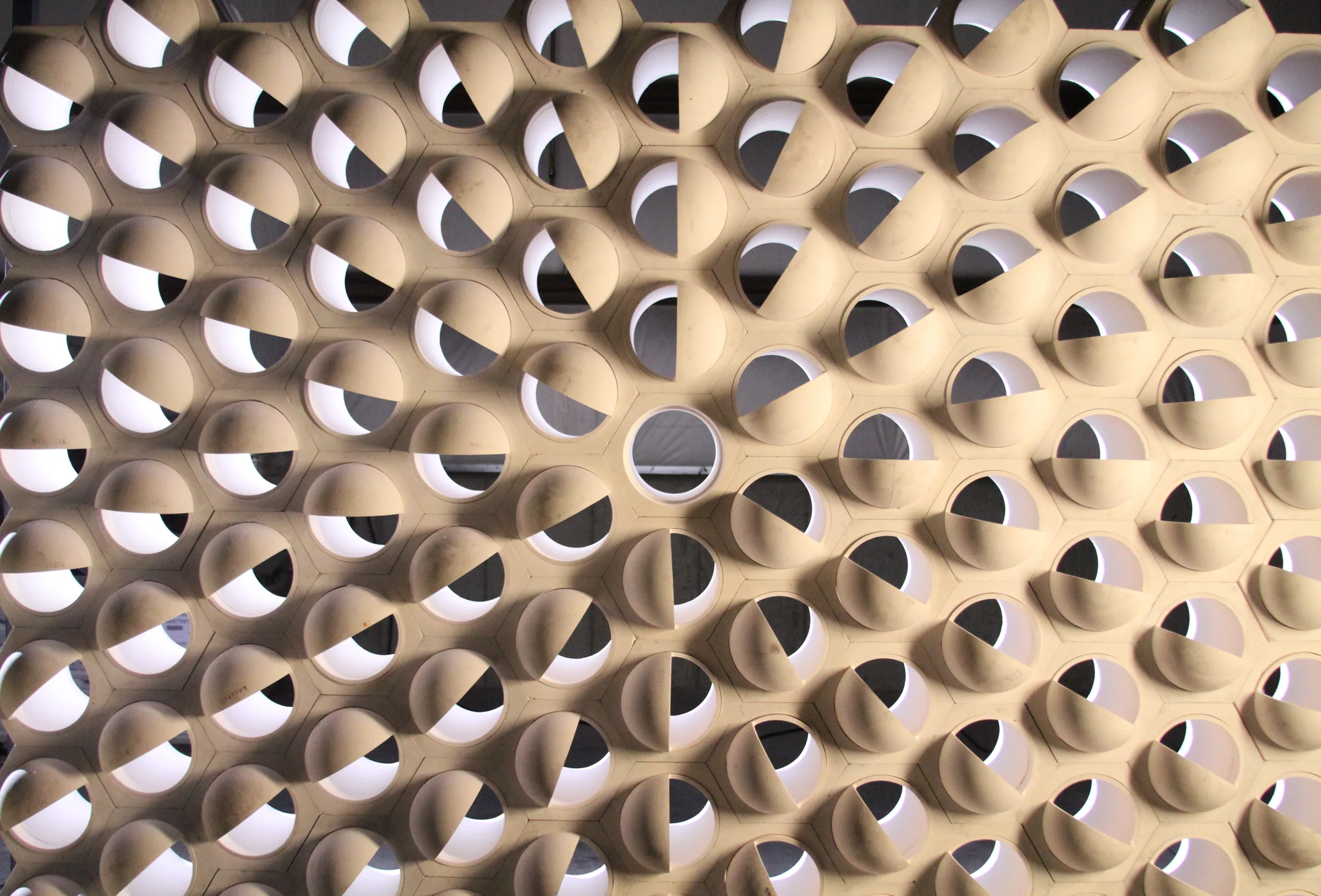
Self-supporting ceramic structures

HexWall checkerwall:
six-sided blocks that lock together

A mortar-free checkerwall for sulfur recovery, sulfur burning and spent acid furnaces, built from interlocking hex blocks.

A checkerwall that stays standing through thermal cycles and upsets,
because every block holds its neighbors.

Interlocking hexagonal checkerwall blocks with round openings
In short

An interlocking hex checkerwall is a perforated furnace wall built from six-sided ceramic blocks that lock to each other with tabs and slots on every side, stacked without mortar. Each block has a round opening, so the ceramic around it works as an arch in compression, and the wall stays stable through heat-up, cool-down and upset conditions. Blasch HexWall is used in Claus reaction furnaces of sulfur recovery units, in sulfur burning furnaces and in spent acid regeneration furnaces.

Stacked cylinders and brick,
or blocks that lock

HexWall was first designed as a stable replacement for walls of stacked ceramic cylinders.

Stacked cylinders and brick walls

  • Cylinders are stacked loose and can fall in a delayed ignition
  • Brick walls lose their mortar joints to thermal cycling
  • Flat brick spans are loaded in tension and slowly sag
  • Each rebuild needs masons and curing time

HexWall

  • Tabs and slots lock every block to its neighbors
  • Round openings keep the ceramic in compression
  • No mortar between blocks, so there is no joint to crack
  • Open and closed blocks can be mixed as the process needs

How a HexWall is built

The blocks are 9 to 18 inches deep and stay stable across furnaces several meters in diameter. The wall sits in a keyway in the furnace lining, or against the hot face brick with one course of brick in front of it and one behind.

Every block is fully supported by its neighbors. Because the blocks are set dry, the wall can be taken down at a turnaround and the blocks set again, and a manway can be built into the wall.

The blocks are cast in a creep resistant, mullite bonded composition. According to Blasch, the blocks remain mechanically stable above 1,650 °C. More on mullite.

Why it stays up

A brick checkerwall depends on its mortar; a HexWall depends on geometry, and geometry does not crack.

Where HexWall runs

The same blocks serve several furnaces in refining and chemical processing.

Claus reaction furnaces

Checkerwalls in sulfur recovery units that hold the gas in the hot zone and shield the waste heat boiler.

Sulfur burning furnaces

Baffle walls in sulfuric acid plants, where a HexWall replaces brick walls that crack.

Spent acid regeneration

Walls in decomposition furnaces, often with staged combustion for lower NOx.

Installation and field experience

A HexWall goes in in about a third of the time of a brick baffle wall, according to a 2015 paper by MECS. In one sulfuric acid plant in late 2013, a new furnace of 1.1 million lb was fully lined before the outage and lifted into place in one piece. The HexWalls inside stayed stable.

In a US sulfuric acid plant, two HexWalls 9 inches thick went into a sulfur burning furnace of 10 ft diameter in 2007. Five years later both were still in service. Other walls followed in spent acid furnaces of 12 ft and about 19.5 ft diameter.

From HexWall to VectorWall

Fit vector tiles into the openings, and a HexWall becomes a VectorWall that steers the gas into a swirl for better mixing. The block system stays the same. In flue gas service, Blasch uses the same principle for StaBlox reformer tunnels.

Frequently asked

Questions about HexWall

What is the difference between HexWall and VectorWall?

HexWall is the block wall itself. VectorWall adds angled tiles to the openings so the wall also controls the flow pattern.

Can a HexWall be taken down and reused?

Yes. The blocks are set without mortar, so a wall can be dismantled for inspection or repair and the undamaged blocks set again.

How large can a HexWall be?

Walls for furnaces several meters across are common, and the larger the furnace, the deeper the block used.

Does it work with oxygen enrichment?

Yes. HexWall is used as the base for checkerwalls in oxygen-enriched furnaces.

Full checkerwall of hex blocks with angled openings

Rebuilding a checkerwall
at every turnaround?

Send the furnace diameter and the wall you run today. A Blasch engineer lays out the HexWall for your furnace.

Talk to an engineer Call