Degassing and die casting

Ceramic thermocouple protection tubes
for molten metal and hot gas

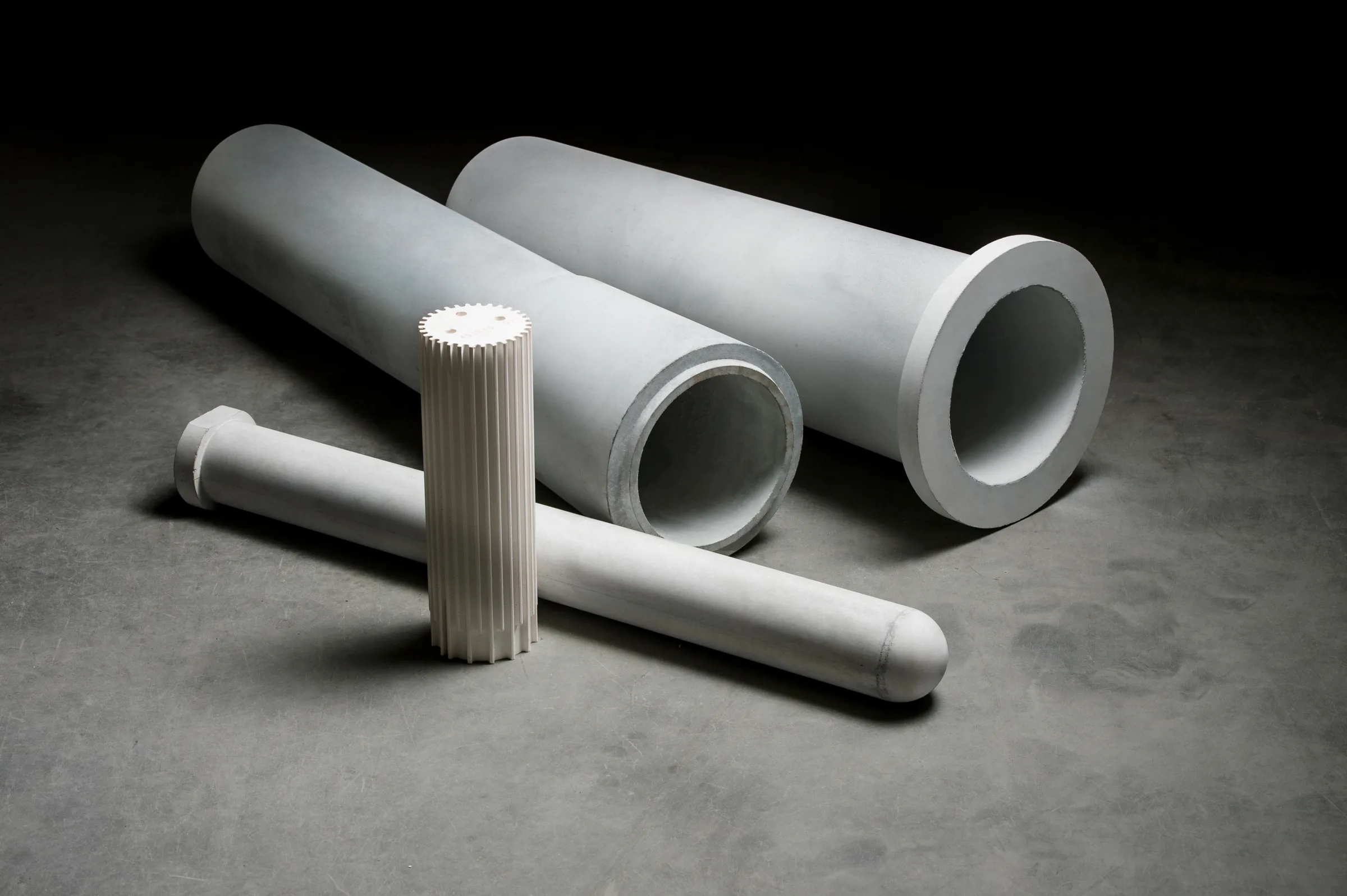
Silicon carbide, mullite and alumina tubes that shield the thermocouple and pass the temperature through quickly.

The reading is only as good as the tube around the thermocouple.
Dross on the tube means a slow and wrong number.

Ceramic thermocouple protection tubes
In short

In molten aluminum, a ceramic thermocouple protection tube of silicon carbide works best: OXYTRON oxide bonded or NITRON nitride bonded silicon carbide, in a non-wetting grade or with a treatment for aluminum, so dross does not build up on the tube. Silicon carbide conducts heat well, which gives a fast and steady reading, and it survives the thermal shock of being dipped. Blasch standard tubes have a 1.75 in outside diameter, a 1 in bore and lengths from 9 to 48 in, with a reusable stainless steel coupling.

What a thermocouple protection tube does

A thermocouple measures temperature at the junction of two wires. In a furnace, a kiln or a melt, those wires would be attacked within hours, so they sit inside a closed end tube that takes the chemical attack, abrasion, impact and thermal shock.

The protection tube is the outer shield. Inside it, a thin insulating tube keeps the thermocouple wires apart. Only the protection tube touches the process, and its wall decides how fast heat reaches the junction.

Metal tubes are common in air and in gases at moderate temperatures. In molten aluminum, steel and cast iron are dissolved by the melt, and in corrosive or very hot gases they scale, which is where a ceramic tube takes over.

The number you control

Every setpoint in the holding furnace depends on one reading, and that reading drifts as soon as dross insulates the tube from the metal.

Choosing the tube material

Material Where it fits
OXYTRON oxide bonded SiC Molten aluminum, non-wetting, high thermal conductivity
NITRON nitride bonded SiC Molten aluminum and copper alloys, thermal shock
Alumina Kilns and furnaces with hot gases, no molten metal contact
Mullite Kilns and furnaces with thermal cycling

Non-wetting grades and treatments are available for aluminum and copper based alloys. Silicon carbide tubes are rated up to 3,000 °F and do not oxidize at those temperatures.

Nitride bonded silicon carbide properties

Standard sizes and features

Standard tubes have a 1.75 in (44.5 mm) outside diameter and a 1 in (25.4 mm) inside diameter, with or without a flange.

Standard lengths
9 in (228.6 mm) 30 in (762.0 mm)
12 in (304.8 mm) 36 in (914.4 mm)
18 in (457.2 mm) 42 in (1,066.8 mm)
24 in (609.6 mm) 48 in (1,219.2 mm)

Features cast into the tube

Because the tube is cast, mounting details come with it instead of being machined or added.

Reusable coupling

Closed end tubes with a stainless steel coupling that moves to the next tube.

Cast threads

Male or female threads cast into the ceramic for direct mounting.

Flanges and grooves

Mounting flanges, cross pinholes and O-ring grooves for quick installation.

Beyond the aluminum cell

Protection tubes from the same range are used in kilns, furnaces and chemical processing, wherever a temperature reading has to survive abrasion, heat or corrosive gas. Ceramics for industrial process heating

In the aluminum holding furnace, the tube works next to ceramic immersion heater tubes in the same non-wetting materials. For transfer, non-wetting auto ladles complete the cell.

Degassing and die casting overview

Frequently asked

Questions about thermocouple protection tubes

What temperature can a ceramic protection tube handle?

Silicon carbide tubes from Blasch are rated up to 3,000 °F. The limit for your case depends on the medium and on thermal cycling.

Why do protection tubes in aluminum build up dross?

Aluminum wets many materials and oxide grows on the wetted surface. Non-wetting silicon carbide reduces that buildup and keeps the reading closer to the metal temperature.

Can I keep my existing coupling?

The standard tubes come with a reusable stainless steel coupling. For other couplings, the tube end can be cast with threads, a flange or an O-ring groove to fit.

Do you make tubes in other diameters and lengths?

Yes. Besides the standard sizes, tubes are cast to custom dimensions and shapes.

Ceramic immersion heater tubes

Tubes that fail
before the thermocouple does?

Tell us the medium, the temperature and the length you need. A Blasch engineer recommends the material and the mounting.

Talk to an engineer Call