Degassing and die casting

DuraLadle ceramic auto ladle:
aluminum that does not stick

A non-wetting OXYTRON ladle for high pressure die casting, with a reusable holder for the major ladle machines.

No ladle wash, no buildup to chip off.
The ladle pours the same shot in month three as on day one.
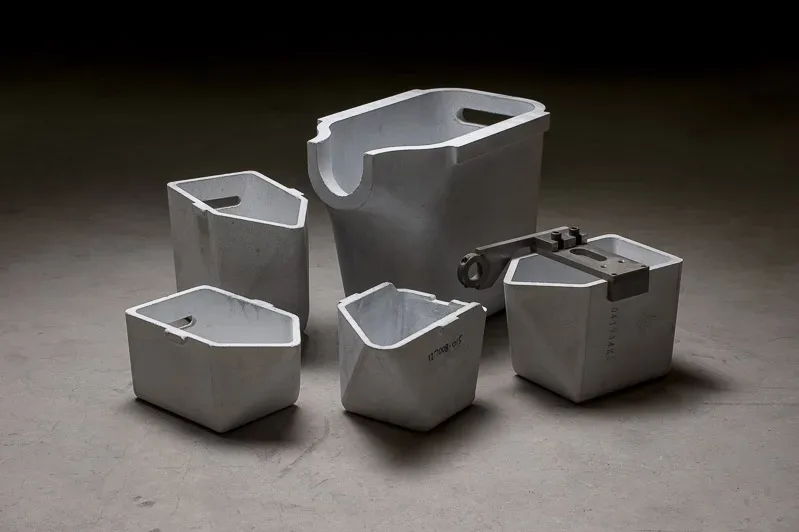
Ceramic auto ladle cups
In short

A non-wetting ceramic auto ladle needs no coating because molten aluminum does not stick to it: there is no buildup to prevent and no iron surface to protect from the melt. DuraLadle is made of OXYTRON oxide bonded silicon carbide, which stays completely non-wetting in molten aluminum, so the ladle runs for months without coating or maintenance. A reusable metal holder fits all major auto ladle machines, and ladles cover shot sizes from 5 to 50 lb.

Why metal ladles need a coating

An auto ladle dips into the holding furnace, takes one shot of aluminum and pours it into the shot sleeve of the die casting machine, hundreds of times per shift.

Steel and cast iron ladles are wetted and attacked by molten aluminum. They are coated to keep the metal from sticking and to slow the attack, and the coating wears off with every cycle. Aluminum and oxide build up in the bowl, the shot weight drifts, and the ladle comes out for cleaning and recoating.

Every stop for the ladle is a stop for the cell.

Coated metal ladle
or non-wetting ceramic

Same machine, same shot. The difference is what happens between changes.

Coated steel or iron ladle

  • Coating applied and renewed on a fixed schedule
  • Aluminum and oxide build up in the bowl
  • Shot weight drifts as the buildup grows
  • Iron from the ladle can enter the melt

DuraLadle in OXYTRON

  • No coating, at any point in its life
  • Aluminum does not wet the ceramic, so little builds up
  • Months of service without maintenance
  • Rear submerged fill port takes metal from below the oxide skin

Nothing to protect

A ladle that aluminum does not wet has nothing to protect and nothing to clean, so the time you spent on ladle maintenance goes back to casting.

Sizes and the reusable holder

Shot size Metric
5 lb 2.3 kg
8 lb 3.6 kg
10 lb 4.5 kg
12 lb 5.4 kg
15 lb 6.8 kg
17 lb 7.7 kg
50 lb 22.7 kg

The universal metal holder is reusable and comes with brackets for all major auto ladle machines. A ladle change means swapping the ceramic bowl in the holder, which keeps changes fast and the pour position the same.

The optional rear submerged fill port fills the ladle from clean metal below the surface, so less oxide from the bath surface ends up in the shot.

The material behind it

OXYTRON has been used by Blasch in molten aluminum for decades, in immersion heater tubes and other non-ferrous parts, before it became an auto ladle. Oxide bonded silicon carbide properties

More non-wetting parts for the die casting cell

DuraLadle is part of the degassing and die casting range.

Ceramic immersion heater tubes

Immersion heater tubes

Silicon carbide tubes that heat the holding furnace from inside the melt.

Heater tubes for holding furnaces
Rotary degasser parts, porous plugs and lances

Rotary degassers and plugs

Porous ceramics that remove hydrogen before the metal reaches the ladle.

Degassing rotors and porous plugs
Ceramic launders, snouts and tundishes

Launder linings

Smooth cast channel linings for metal transfer from melter to holding furnace.

Launders and tundishes
Frequently asked

Questions about the DuraLadle auto ladle

Does DuraLadle really need no coating?

Yes. OXYTRON is non-wetting in molten aluminum, so the ladle is used without any coating for its whole service life.

Which auto ladle machines does it fit?

The reusable holder comes with brackets for all major auto ladle machines.

How long does a DuraLadle last?

Months of service without maintenance, depending on alloy, temperature and cycle rate.

Can I trial a DuraLadle on one machine?

Yes. Blasch offers DuraLadle trials, so you can run one cell before changing the rest. Tell us the machine and the shot size.

Ceramic rotary degasser shafts and rotors

Ladle maintenance
stopping your cells?

Send the machine type and the shot size. A Blasch engineer proposes the ladle size and the holder brackets.

Talk to an engineer Call