Degassing and die casting

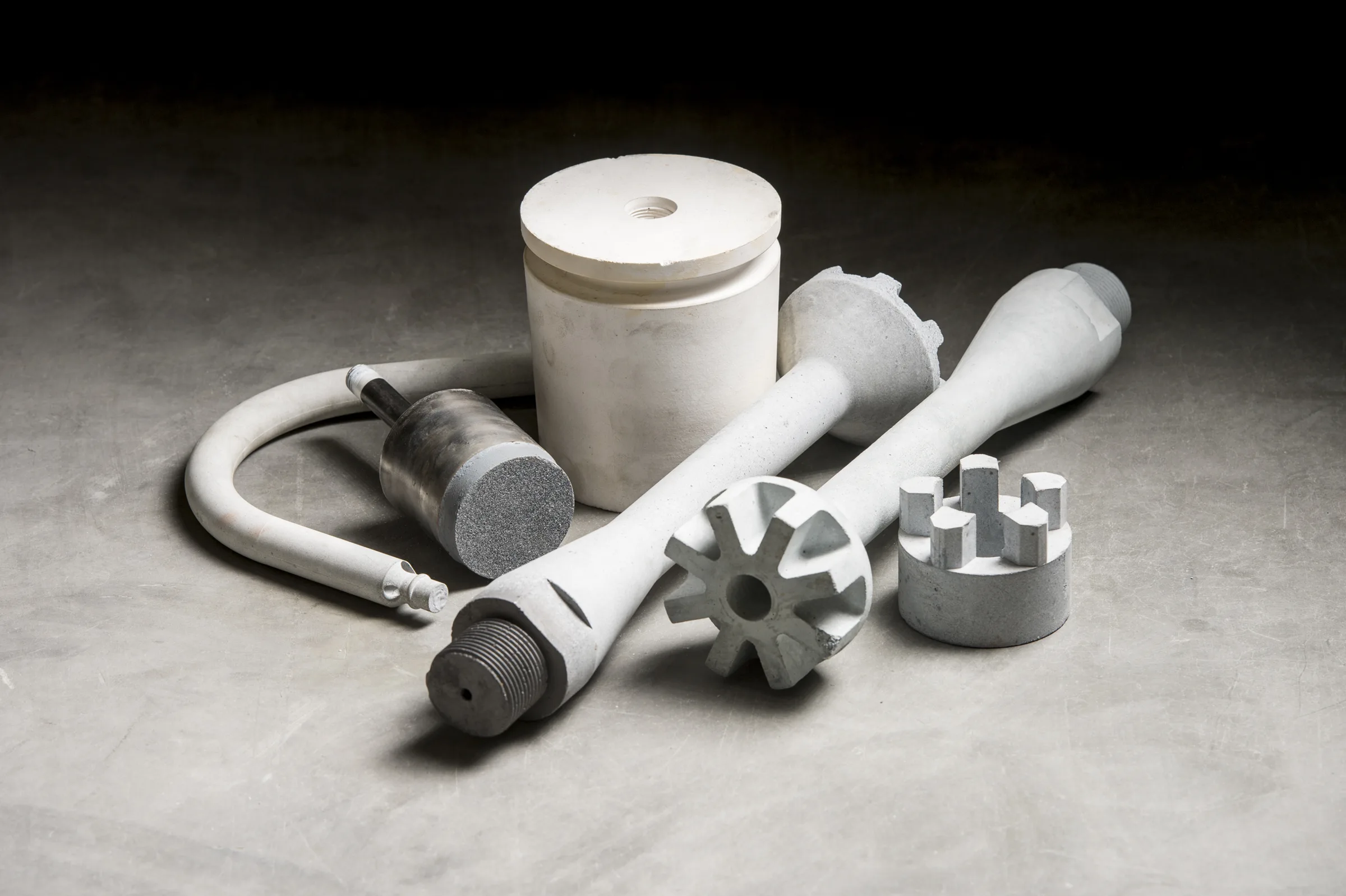
Aluminum degassing rotors, plugs and lances
in non-wetting ceramic

One-piece rotary degassers, porous plugs, lances and diffuser plates for hydrogen removal from aluminum, copper and zinc alloys.

Smaller pores make smaller bubbles.
Smaller bubbles take out more hydrogen per cubic foot of gas.

Ceramic rotary degasser shafts and rotors
In short

Ceramic alternatives to graphite in aluminum degassing are one-piece rotary degassers, porous plugs, porous lances and diffuser plates made of a non-wetting silicon carbide and alumina composite. The material has roughly 250% the strength of silica and a pore size around 5 microns, about a tenth of the usual 50 to 100 microns, so it produces fine bubbles and lets almost no metal into its pores. Unlike graphite, the ceramic does not burn away where it meets air above the melt, and threads cast into the part often make the metal sheath around the plug unnecessary.

Static and dynamic degassing with ceramic

Static: porous plugs in the furnace floor and porous lances dipped into the melt release inert gas through the ceramic itself. Plugs come in 3 to 10 in, lances in 24 to 36 in.

Dynamic: a rotary degasser on a shaft spins in the melt, typically at 200 to 400 rpm, and shears the gas into small bubbles that spread through the whole bath.

Diffuser plates: flat porous plates that spread gas over a larger area of a ladle or furnace bottom.

Both methods rely on the same physics: hydrogen leaves the aluminum into the bubbles as they rise. The finer the bubbles, the more surface they offer and the less gas is needed for the same result.

What the pore decides

A porous plug is only as good as its smallest pores: they set the bubble size, and they decide whether gas goes into the melt or metal goes into the plug.

What the ceramic changes

Four things the ceramic does differently in the melt.

Pores around 5 microns

Fine bubbles for more efficient hydrogen removal with less inert gas.

No metal penetration

Tight porosity lets gas through but keeps aluminum out, so plugs do not clog or need frequent cleaning.

Cast threads

Threads cast into the part replace a separate metal can, which with chlorine has to be an expensive nickel alloy.

Precise rotor fit

Rotors are cast to close tolerances so they fit the shaft and run true at speed.

Material and patents

The porous degassing material is a silicon carbide and alumina composite with a non-wetting additive. It resists wetting by aluminum, copper, zinc and galvalume, so the same parts work beyond aluminum. The porous degasser design is covered by US Patent 6,378,847.

Parts are available as single components or as canned assemblies, configured for static or dynamic use.

Degassing is one step in the melt shop. The holding furnace needs immersion heater tubes and thermocouple protection tubes in the same non-wetting family.

All degassing and die casting parts

Frequently asked

Questions about ceramic degassing parts

Can a ceramic rotor replace a graphite rotor?

Yes, as a one-piece rotary degasser cast to fit your shaft. Ceramic does not oxidize in air at melt temperature the way graphite does.

Why does pore size matter in a porous plug?

Pore size sets the bubble size. Pores around 5 microns give fine bubbles and keep molten metal from entering the plug.

Do ceramic porous plugs need a metal housing?

Often not. Threads are cast into the ceramic, so the costly metal can used with chlorine can usually be left out.

Which metals can be degassed with these parts?

Aluminum, and also copper, zinc and galvalume alloys.

Rotary degasser parts, porous plugs and lances

Too much gas,
too little hydrogen removed?

Tell us the furnace or ladle, the alloy and how you degas today. A Blasch engineer proposes plug, lance or rotor and the right size.

Talk to an engineer Call