Materials

Nitride bonded silicon carbide:
wear resistance for large shapes that see heat swings

NITRON from Blasch, 70% silicon carbide bonded by silicon nitride, for cyclone linings, nozzles, heater tubes and large wear shapes.

Large cyclone cones, spray nozzles and heater tubes that wear, get hot and cool down again.
NITRON is cast for that combination.
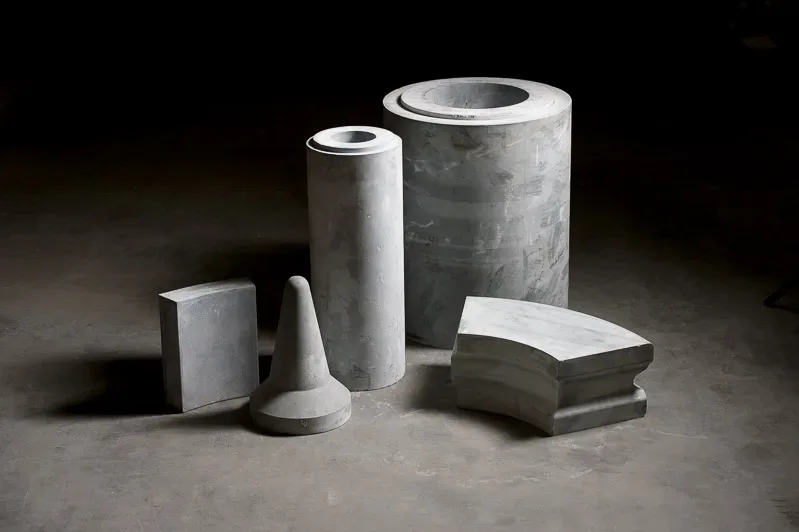
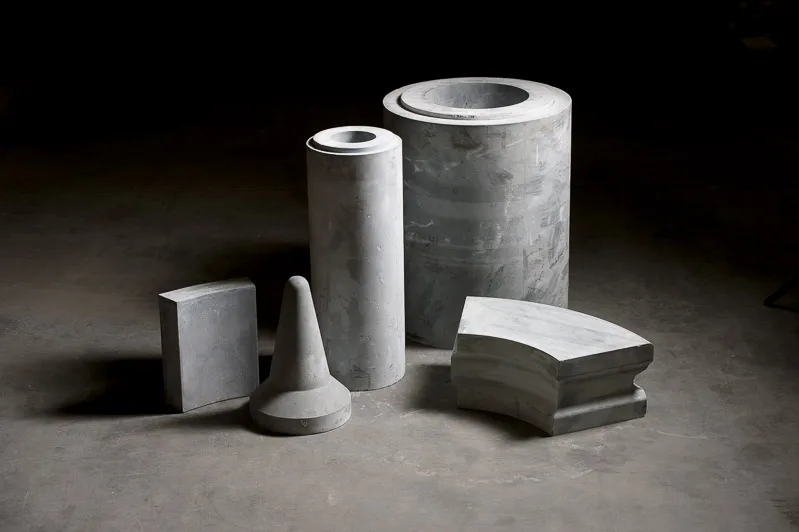
Cast nitride bonded silicon carbide shapes
In short

Nitride bonded silicon carbide is silicon carbide whose grains are held together by silicon nitride, which gives it good erosion and corrosion resistance, high thermal conductivity and a thermal shock tolerance that dense ceramics lack. Blasch NITRON contains 70% SiC, 21% Si3N4 and 8.5% silicon oxynitride, has 16% apparent porosity and a modulus of rupture of 6,000 psi. It is used for cyclone and hydrocyclone liners, spray nozzles, immersion heater tubes and large wear shapes that would spall in a denser ceramic.

Cast nitride bonded silicon carbide shapes

How nitride bonded silicon carbide is made

Silicon carbide grains do not bond to each other on their own. In nitride bonded silicon carbide, the bond forms during firing in nitrogen: silicon in the mix reacts to silicon nitride, which grows between the SiC grains and locks them together.

Because the bond forms in place, the part shrinks very little during firing. That is why nitride bonded silicon carbide suits large shapes and tight tolerances, and why NITRON parts come out of the Blasch process with uniform properties throughout the part.

NITRON is the Blasch grade. It is cast net shape, from small nozzles to large linings for cyclones and quench vessels. How the Blasch process works

Properties of NITRON nitride bonded silicon carbide

Values from the Blasch NITRON product information sheet.

Property NITRON
Composition 70% SiC, 21% Si3N4, 8.5% Si2N2O
Apparent porosity 16%
Modulus of rupture 6,000 psi
Thermal conductivity 115 BTU·in/hr·ft²·°F
Coefficient of reversible thermal expansion 2.6 x 10⁻⁶ in/in·°F

What these numbers mean in service: the high thermal conductivity and low expansion keep temperature differences inside the part small, so NITRON resists cracking and spalling under rapid temperature change. The open porosity is part of that: it lets the structure absorb stress that would crack a fully dense body.

Compared with steel and rubber: in abrasive slurry and pneumatic service, NITRON reduces spalling and erosion and lasts much longer than steel or rubber linings. For the heaviest impact abrasion, the denser reaction bonded silicon carbide is the next step up.

Wear is rarely the only load

In a real plant the part that wears also heats, cools and gets knocked, and nitride bonded silicon carbide is chosen because it takes all three without spalling.

Blasch parts made from NITRON

From small nozzles to large linings, each part designed for its duty.

Cyclone and hydrocyclone liners

Cones, apexes and inlet scrolls in one piece, for slurry and dust.

Hydrocyclone liners

FGD and spray nozzles

Spray nozzles for scrubbers that resist erosion and do not clog.

FGD spray nozzles

Immersion heater tubes

Heater sheaths for molten aluminum and zinc with good heat transfer.

Immersion heater tubes

Impingement and quench linings

Large NITRON shapes for blast shrouds, quench vessels and impingement blocks.

Impingement block linings

More NITRON parts

NITRON is also used for abrasion resistant valves, in line chokes and reducers, rotary degassers and porous plugs and dust collector components, and as one of the liner grades in CeraLine lined pipe and elbows. In copper and aluminum alloys it combines non wetting with thermal shock resistance.

NITRON parts work in mining, power generation and molten metals. Blasch also makes an oxynitride bonded silicon carbide, OxyNitron, and for molten aluminum the non wetting oxide bonded grades.

Sources

NITRON values and uses: Blasch NITRON product information sheet; Blasch heavy industry and nonferrous presentations. Nitride bonding of silicon carbide: W. D. Kingery, H. K. Bowen, D. R. Uhlmann, Introduction to Ceramics, 2nd ed., Wiley, 1976.

Frequently asked

Questions about nitride bonded silicon carbide

Is nitride bonded silicon carbide the same as silicon nitride?

No. It is mostly silicon carbide; silicon nitride is only the bond. Pure silicon nitride is a different, fully dense ceramic.

Nitride bonded or reaction bonded silicon carbide?

Reaction bonded is denser and resists heavy abrasion better. Nitride bonded tolerates thermal shock better and is the economical choice for large shapes.

What temperatures can NITRON take?

Nitride bonded silicon carbide is a refractory grade used in hot service and molten metal. Ask a Blasch engineer for the limit in your atmosphere and load.

Does NITRON need a coating?

No. NITRON is a solid cast part; its wear resistance comes from the material itself, not from a surface layer.

Cast nitride bonded silicon carbide shapes

Large wear parts that spall
or wear through?

Send the dimensions, the medium and the temperature range. A Blasch engineer checks whether NITRON or another grade fits best.

Talk to an engineer Call