Wear products

Hydrocyclone liners
for coarse, abrasive mineral slurry

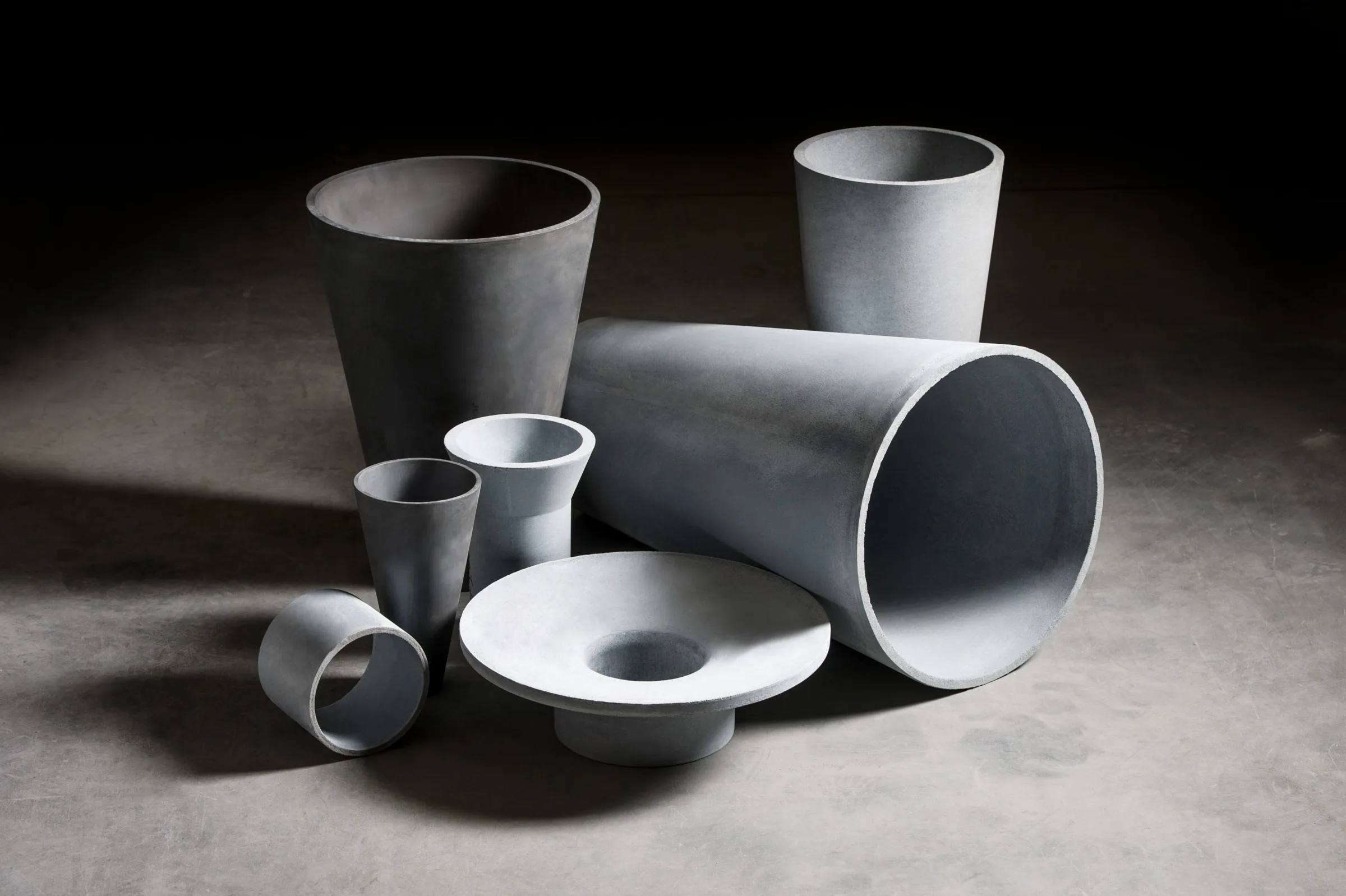
One-piece silicon carbide apexes, cones and cylinders, with an optional polyurethane backing.

Apex, spigot and cone cast in silicon carbide.
Backed with polyurethane where the cyclone sees impact.

Hydrocyclone liners encased in polyurethane
In short

For coarse, highly abrasive mineral slurry, cast silicon carbide is the hydrocyclone liner material that keeps its shape longest in the high wear zones: the apex, the spigot and the lower cone. Blasch casts these liners in one piece in several silicon carbide grades or dense alumina, which resist abrasion better than cast steel, rubber or urethane alone, and can encase them in polyurethane to take impact. You can order the complete liner set or only the high wear parts, so the rest of the cyclone keeps its current lining.

Where a hydrocyclone wears

Slurry enters the feed head tangentially and spins down through the cylinder and the cone. The coarse fraction leaves through the apex and spigot, the fines and most of the water through the vortex finder at the top.

Wear is heaviest where the solids are coarsest and fastest: at the feed inlet and in the lower cone and apex. As the apex wears open, the split between overflow and underflow drifts, and the cut size moves long before the liner leaks.

That is why liner life in a hydrocyclone is measured twice: in hours until the part has to come out, and in how long it holds the classification you set at startup.

Tiles glued in,
or one cast piece

Ceramic is the standard answer to slurry abrasion. The open questions are how it is installed and what happens when it cracks.

Ceramic cyclone and hydrocyclone liners, cones and tubes

Epoxied tile liners

  • Many tiles set by hand in epoxy inside the housing
  • Long installation, and every joint becomes a wear point
  • A broken tile can travel into the equipment downstream

Cast silicon carbide with VERKAPSE

  • One-piece liners that drop into the existing housing
  • A polyurethane backing that absorbs impact and vibration and holds a cracked liner in place
  • Ceramic and encapsulation from one supplier, made in the same plant

What the apex controls

A hydrocyclone separates only as well as its apex holds its shape, so the liner that keeps its bore longest also keeps your cut size where you set it.

Liner parts for
the whole cyclone

Blasch supplies the full liner set for a hydrocyclone or the parts that wear first. Each part is cast to repeatable tolerances, so the next one fits like the last.

Apex and spigots

The highest wear zone of the cyclone, cast as single pieces that can be changed without touching the cone.

Cones and cylinders

One-piece sections up to 60 inches in diameter, with shiplaps and mating joints cast into the ends.

Feed heads and vortex finders

Volute inlet heads and vortex finders, precision cast to assemble into the hydrocyclone you already run.

Vortex finders and thimbles

Choosing the liner material

The grades are reaction bonded silicon carbide (InVinCer RB), nitride bonded (NITRON), alumina bonded (ALTRON), oxide bonded (OXYTRON), sintered silicon carbide (ULTRON) and dense alumina. Which one fits depends on particle size and hardness, solids content, pH and temperature. Reaction bonded silicon carbide

The silicon carbide grades weigh about a third as much as comparable cast steel parts, which makes a liner change on a large cyclone a lighter lift.

Blasch liners run in coal, iron ore, gold, copper and phosphate processing, in cement plants, in pulp and paper, and in wet flue gas desulfurization. Ceramics for mining and mineral processing

The pumps that feed the cyclone wear on the same slurry. Their liners are covered on the page for ceramic pump components, and the full range on wear products.

Frequently asked

Questions about hydrocyclone liners

Is silicon carbide too brittle for a hydrocyclone?

Ceramic can crack when oversize material hits it. The polyurethane backing exists for that case: it absorbs the impact and keeps a cracked liner in one piece until the next planned change.

Can I order only the apex and spigot?

Yes. Apex and spigot are cast as separate parts that fit the existing cone, so they can be replaced on their own.

How large can a one-piece liner be?

Cones and cylinders are cast up to 60 inches in diameter. Small cyclones start at about one inch.

Who does the polyurethane encapsulation?

Blasch does, in house. Earlier, the ceramic inserts went to a separate shop for encapsulation, which added a second supplier and more lead time.

Ceramic shapes for mining and mineral processing

Which part of your cyclone
gets changed first?

Send the cyclone size, the ore and the slurry conditions. A Blasch engineer proposes the liner parts and the grade for that duty.

Talk to an engineer Call