
Engineering

Engineered ceramics,
from your dimensions to the installed part

Material selection, design, modeling, testing and manufacturing, with one engineer as your contact.

You describe what fails and where.
Blasch engineers choose the ceramic, design the part and make it.
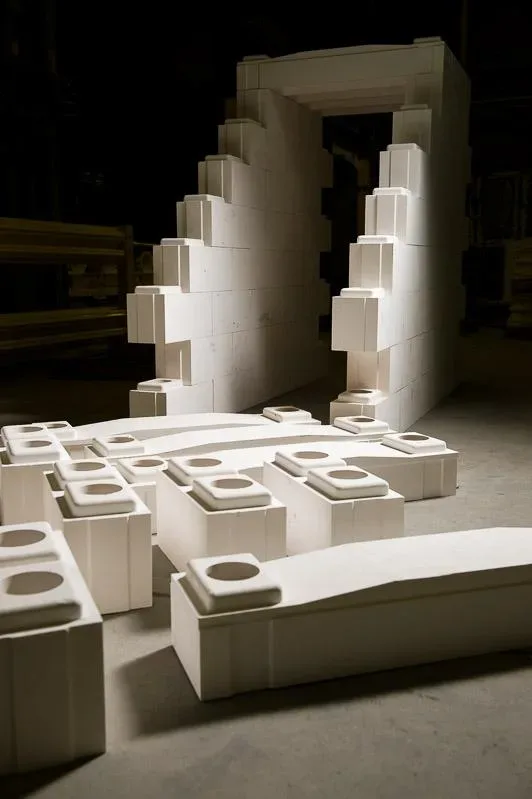
Stacked precast ceramic blocks forming an opening
In short

Engineered ceramics are ceramic and refractory components designed for one application, from its dimensions, temperatures, media and loads, instead of being picked from a standard range. At Blasch, that work runs from the first description of a failure to a part that drops into your equipment: material selection from more than 15 grades, design with CFD and FEA where the application needs it, in-house testing, near net shape casting in Albany, New York, and support at installation. A drawing is not required; dimensions and operating conditions are enough to start.

Catalogue part
or engineered part

A catalogue part fits many plants a little. An engineered part fits one position in one plant, and is designed around the way the old part failed.

Custom engineered ceramic shapes including a perforated plate

From a catalogue

  • Standard sizes, adapted on site with cutting and mortar
  • One grade for many duties
  • A drawing needed before anyone quotes
  • The same failure at the next turnaround

Engineered by Blasch

  • Designed from your dimensions and operating conditions
  • A grade chosen for the medium, temperature and velocity
  • Flow, heat and stress checked before casting
  • A part designed to drop into the existing system

Where engineering pays

The most expensive part of a ceramic component is not its price but the outage it causes, so the engineering goes into the reason the old part failed.

What the engineering covers

Four parts of the work, each with its own page for the details.

01

Net shape forming

The Blasch process casts complex ceramic parts near net shape, with threads, tapers and changing walls cast in.

The Blasch process
02

Large and complex shapes

Parts from 1 oz to 2 tons, from matchstick size to sewer pipe, and assemblies of many pieces.

Large and complex shapes
03

Modeling and testing

CFD for flow and heat transfer, FEA for stress, and lab tests for thermal shock, abrasion and creep.

CFD, FEA and testing
04

Precast refractory shapes

Fired shapes in place of castable and brick, set without forming, curing or dry out.

Precast refractory shapes

From inquiry
to installed part

One engineer stays your contact from the first call to the outage.

01

Describe the failure

Where the part sits, how it fails, how often, and the dimensions and operating conditions you have.

02

Choose and design

The engineer selects the grade, designs the part and models flow, heat or stress where the application calls for it.

03

Make and check

The part is cast, fired and checked for dimensions, strength and thermal shock behavior.

04

Install

Parts arrive ready to set, often as a drop-in for the existing system, with installation guidance for your crew.

Choosing the ceramic

Blasch has produced more than 110 ceramic mixes. Oxides such as alumina, mullite, zirconia composites and fused silica sit next to silicon carbides with oxide, nitride, alumina or reaction bonds, aluminum titanate and silicon nitride.

The grade follows what attacks the part. Abrasive particles call for a different ceramic than a molten alloy, a thermal shock or an alkali atmosphere. Engineered ceramic materials

Working with licensors and EPCs

Many Blasch parts are designed together with the companies that license or build the process. StaBlox orifice plans are modeled with BD Energy Systems, HexWall and VectorWall for sulfuric acid service are distributed by DuPont MECS, and CeraLoop is sold through Allied Mineral Products.

Made in Albany, or with a partner

Most parts are cast and fired in Albany, New York. When another forming method suits a shape better, Blasch designs it and has it made by a vetted manufacturing partner. Quality is managed under ISO 9001:2015. Quality and certifications

What engineered parts changed
in operating plants

Three installations where the design, not just the material, made the difference.

Two US ammonia plants

one tunnel every 4 hours

All flue gas tunnels in two reformers were replaced in summer 2018 with interlocking blocks set dry by a contractor crew without masons.

To the case

Waste heat boiler retubing

67% faster ferrule installation

Hex head ferrules that close into one surface without castable between them shortened installation compared with round ferrules in an 859 tube boiler.

To the case

CO boiler wall

5 days instead of 3 weeks

A burner wall built from precast tongue and groove shapes went in within five days, where the conventional rebuild was planned for three weeks.

Frequently asked

Questions about ceramic engineering

Do I need a drawing to start?

No. Most inquiries arrive without one. Dimensions, photos of the failed part and the operating conditions are enough for an engineer to design the part.

What are engineered ceramics?

Ceramic components designed and made for a specific application, as opposed to standard catalogue shapes. The material, geometry and installation are all chosen for that one duty.

Can Blasch work from a licensor's specification?

Yes. Blasch regularly designs to licensor and EPC specifications and works with their process models where available.

Does Blasch install the parts?

Installation is done by your crew or refractory contractor. Blasch designs parts for simple installation and provides guidance and support on request.

Blasch Precision Ceramics building with sign in Albany, New York

Describe the part
that fails too early

Send what you know: dimensions, conditions and how it fails. A Blasch engineer takes it from there.

Talk to an engineer Call