
Wear products

Core setters for investment casting:
stable after many firings

High purity ceramic setters that hold airfoil cores true through firing, for aerospace and gas turbine castings.

A ceramic core is only as straight as the setter it is fired on.
Setters cast to the core and stable from one firing to the next.
In short

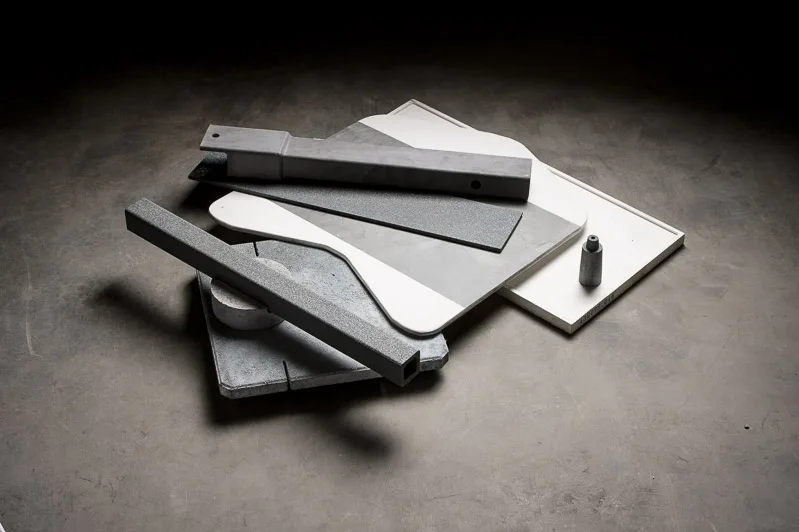
Ceramic cores for turbine airfoils keep their shape in the kiln only if the setter under them keeps its own, so the core setters that reduce distortion are those that resist slumping and movement after repeated firings, hold tight tolerances and follow the geometry of the core. Blasch casts core setters in high purity grades to near net shape, with support surfaces that match the core, and uses FEA to find the setter orientation with the least thermal stress. They are made for aerospace and industrial gas turbine cores.

Why cores distort

A ceramic core for a turbine blade or vane is long, thin and curved. During firing it rests on a setter, and wherever the setter has sagged, warped or moved, the core follows it.

A setter that is accurate when new but slumps a little with every cycle passes that change on to every core fired on it. Distortion shows up later, as scrap in the casting or as cores that have to be sorted out before assembly.

Faster heating and cooling make it harder. Producers push their kilns to raise throughput, and every faster cycle adds thermal stress to the setter as well as to the core.

What the setter passes on

Every core takes the shape of the setter it was fired on, so a setter that stays true through many firings is the cheapest way to keep cores in tolerance.

Three things a core setter
has to do

The setter is designed for the core it carries. These are the properties the design is checked against.

Stay where it is

Resist slumping and movement after repeated firings, so the support surface does not drift with each cycle.

Hold the tolerance

Near net shape casting with a linear tolerance of about plus or minus 0.5%, without secondary machining.

Match the core

Complex support geometry cast in, so the core rests on its intended contact points along its whole length.

How the setters are engineered

Blasch engineers use finite element analysis to see how a setter is stressed in different orientations in the kiln and choose the one with the least stress. The method is described in the white paper Analysis of Thermal Stresses on Core Setters, and a follow-up on kiln conditions and process cost in Improving Thermal Conditions for Core Setters.

Materials are high purity grades such as mullite and alumina. Development work includes ultra high alumina with very low silica for reducing atmospheres, and MgO and spinel based materials where a basic setter is needed. Mullite ceramics

The lab in Albany tests modulus of rupture, density, thermal shock, creep deflection, oxidation and wear resistance on setter materials. Modeling and in-house testing

Setters for metal injection molding, powder metallurgy and battery powders are on plates, saggers and setters, the rest of the kiln furniture range on kiln furniture. Core setters belong to the Blasch wear and high temperature products.

Frequently asked

Questions about core setters

Can you make a setter for our core geometry?

Yes. Send the core model or its dimensions and your firing cycle. A Blasch engineer designs the support surface to match the core.

Why does setter orientation matter?

The same setter sees different thermal stresses depending on how it sits in the kiln. FEA shows which orientation keeps the stress lowest, and that orientation is designed in.

Which industries use these setters?

Investment casting of aerospace and industrial gas turbine components, where ceramic cores form the cooling passages of blades and vanes.

Kiln furniture plates and setters

Cores coming out of the kiln
out of tolerance?

Send the core geometry and the firing cycle. A Blasch engineer designs a setter that holds the core true from the first firing to the last.

Talk to an engineer Call