Kiln furniture

Saggers and setters
for battery cathode and powder metal firing

Industrial saggers, setters, boats and plates for calcining, debinding and sintering, engineered for the chemistry.

The sagger touches the product for the whole firing.
What it gives off, the powder takes up.

Ceramic plates, saggers, boats and setters
In short

In battery cathode calcining, a sagger holds up when its material resists attack by the lithium compounds in the powder and survives the thermal cycling of the kiln without spalling into the product. In MIM and powder metal sintering, setters and boats must stay flat and clean in hot hydrogen, which favors low silica, high purity alumina. Blasch casts saggers, setters, boats and plates near net shape in grades chosen for the chemistry of your powder and the atmosphere of your furnace.

Why battery cathode saggers wear out

Cathode active materials are calcined in saggers that travel through roller hearth or pusher kilns in many repeated cycles. Three things limit their life.

Chemical attack: lithium compounds react with the silica and alumina in the sagger wall. The reacted layer expands differently from the body underneath and starts to flake.

Thermal cycling: every pass heats and cools the sagger. Cracks start at corners and at the base, where the wall is thickest.

Contamination: flakes and reaction products end up in the powder. For a cathode material that is a quality problem long before the sagger is mechanically worn.

Materials for battery saggers

Common saggers combine cordierite, mullite and alumina, which handle thermal shock but contain silica that lithium attacks. High purity alumina lowers the silica and with it the reaction. For strongly basic chemistry, Blasch is developing magnesia and spinel based grades, and recrystallized silicon carbide is an option where its thermal conductivity speeds up the firing.

The right choice depends on the cathode chemistry, the peak temperature and the atmosphere, so the grade is set per process, together with your process engineers. Battery materials manufacturing

Quality starts at the sagger

A sagger that sheds nothing into the powder protects the cathode batch, and that is worth more than any number of extra firing cycles.

Setters, boats and plates

The same casting process makes the flat and shaped carriers for sintered parts.

MIM and PIM setters

Flat setters for metal and ceramic injection molded parts during debinding and sintering, with features cast in to hold parts.

Pusher plates and plates

Powder metal sintering fixtures

Boats and fixtures for powder metal parts in hydrogen and nitrogen atmospheres, in low silica alumina.

High purity alumina

Airfoil core setters

Setters that support ceramic cores for turbine blade casting while they fire, designed against thermal stress.

Core setter study

Hot hydrogen and silica

In a sintering furnace with a hydrogen rich atmosphere, silica in the setter is reduced to volatile silicon monoxide and water. The setter loses strength and the parts on it can pick up silicon. Ultra high alumina with minimal silica is made for exactly these conditions.

Cast to the product

Blasch sagger and setter shapes are cast near net shape with tight tolerances, low shrinkage and controlled porosity, so a flat setter does not need grinding and a sagger can carry ribs, feet or stacking features from the mold.

Dental zirconia, technical ceramics and electronic parts are fired on Blasch setters as well, wherever the carrier must not react with the part.

Throughput and thermal shock

Powder producers and parts makers push their furnaces faster on heat up and cool down to raise output. That raises the thermal shock on every sagger and setter, which is why the grade is chosen for the cycle, not only for the peak temperature.

Frequently asked

Questions about saggers and setters

Which sagger material resists lithium attack?

Materials with less silica react less. High purity alumina, and for strongly basic chemistry magnesia or spinel based grades, are the usual directions.

Why do saggers contaminate cathode powder?

The reacted surface layer flakes off after repeated cycles and falls into the powder. A grade that reacts less sheds less.

Can you make saggers to our kiln and stacking?

Yes. Saggers are designed to your kiln and stacking height, from the dimensions of your current sagger.

Do you make setters for MIM parts?

Yes. PIM and MIM setters are cast flat in grades for debinding and sintering in hydrogen or nitrogen.

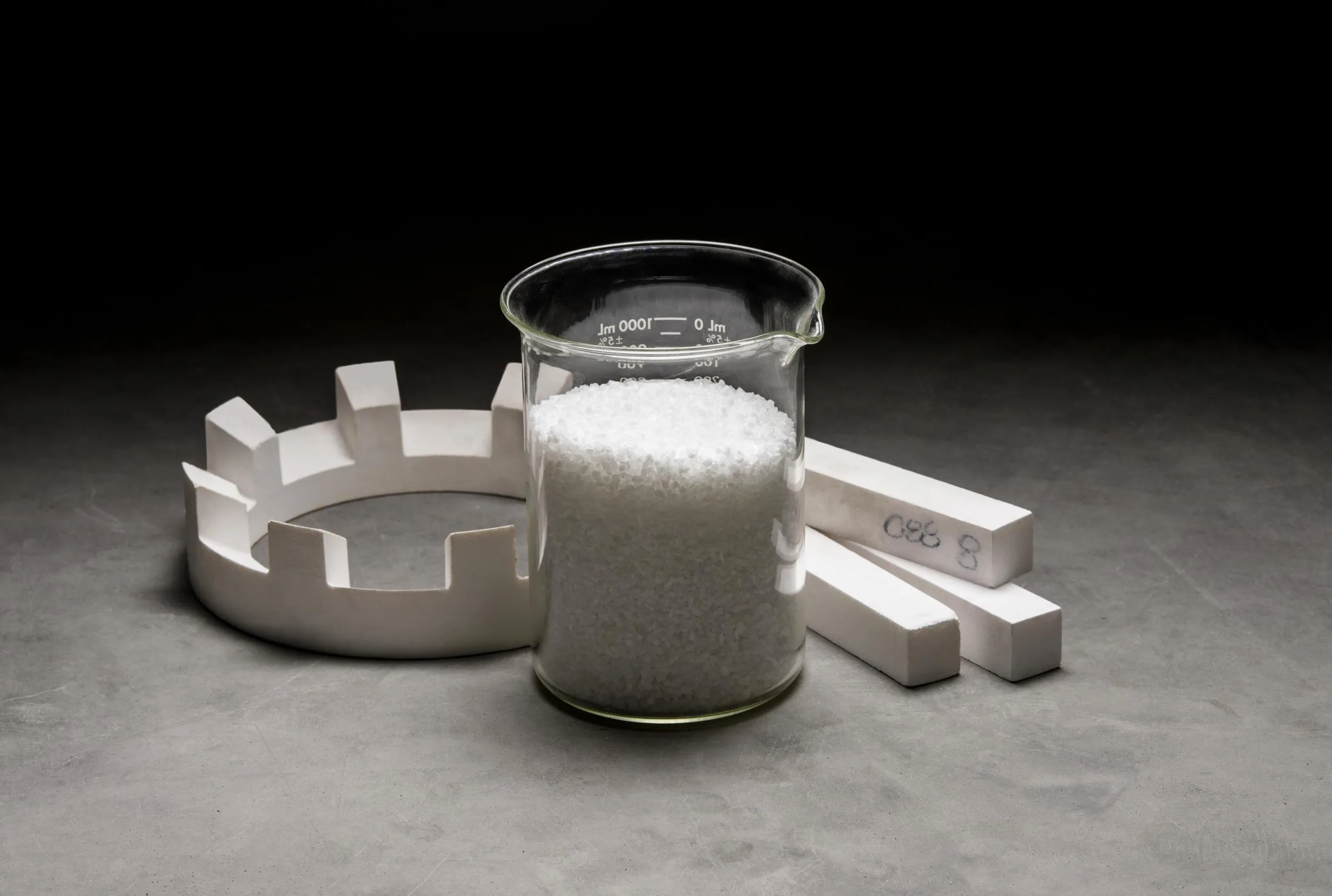
White alumina parts and alumina powder in a glass beaker

Saggers that shed
into your powder?

Send the cathode chemistry, peak temperature, atmosphere and the current sagger size. A Blasch engineer suggests a grade and a sagger design.

Talk to an engineer Call