Technical Library

Reliability in recovery:
the SRU thermal section, part by part

Where the mechanical reliability of a sulfur recovery unit is decided: the checkerwall in the reaction furnace and the ferrules at the boiler tubesheet.

The SRU has to run whenever the refinery runs.
Two ceramic parts decide whether it can.

Ceramic ferrule heads and stems on a stone floor
In short

This Hydrocarbon Engineering article deals with improving and maintaining the mechanical reliability of the sulfur recovery unit. In the thermal section, two refractory parts fail most often: the checkerwall in the Claus reaction furnace and the refractory that protects the waste heat boiler tubesheet. Both fail for the same reason, thermal cycling of mortar or castable, and both can be built from interlocking precast ceramic parts instead.

About this paper

  • Publication: Hydrocarbon Engineering, March 2014
  • Publisher of the summary: Blasch Precision Ceramics
  • Topic: mechanical reliability of the SRU thermal section
  • Full text: available on request; the full article was not available to us, so this page draws on other published Blasch articles on the same parts

The SRU sets the refinery's pace

When the sulfur recovery unit stops, the units that make sour gas have to slow down or stop with it, so a failed checkerwall is a refinery problem.

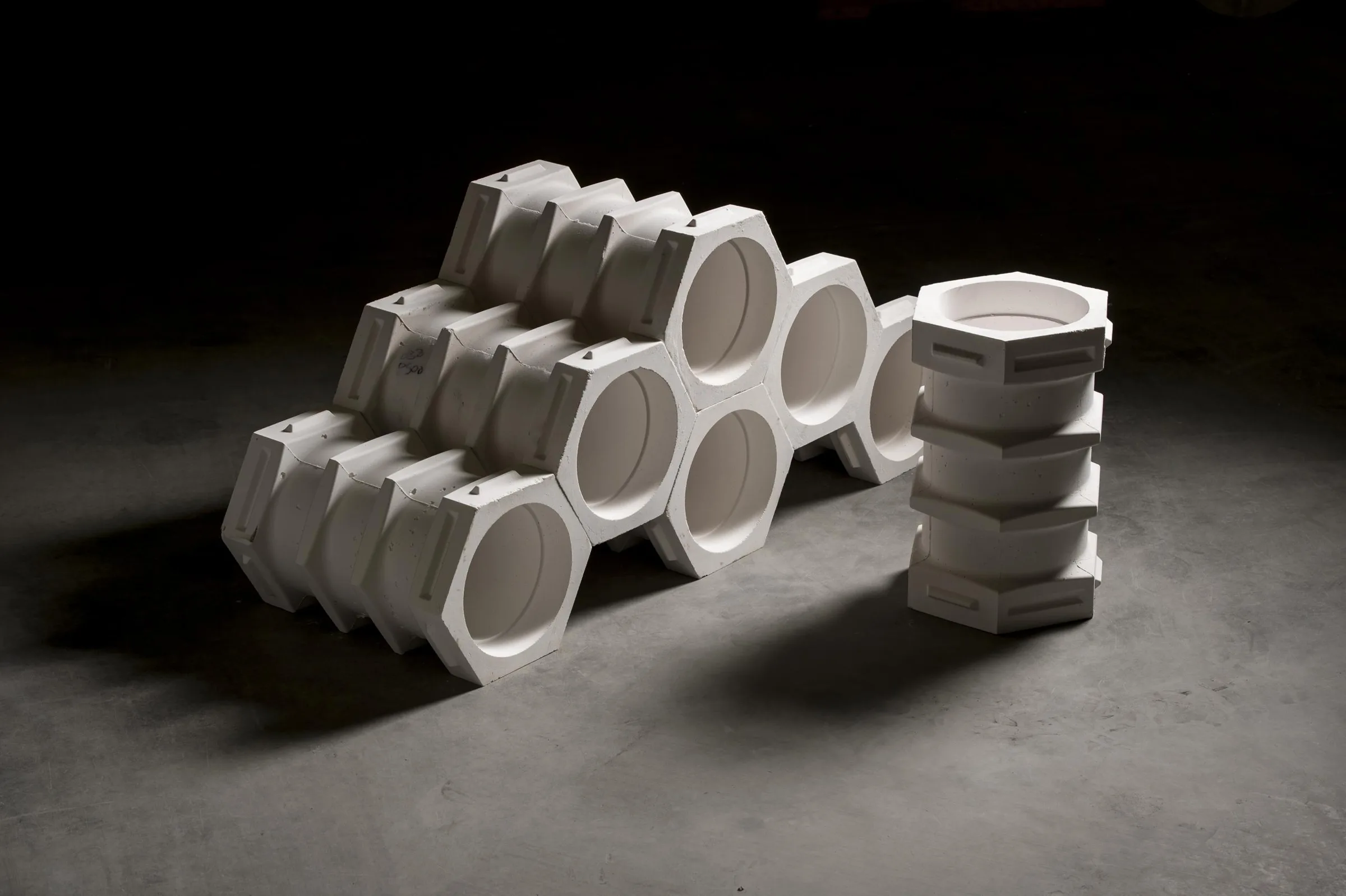
Interlocking hexagonal ceramic checkerwall blocks

The checkerwall

Conventional checkerwalls of brick and mortar, matrix walls and stacked cylinders often do not last a campaign. Mortar cracks under thermal cycling, flat spans are loaded in tension and creep, and loose cylinders can topple after a delayed ignition.

The HexWall checkerwall uses hexagonal blocks stacked without mortar and locked by tabs and slots. Round openings carry load as arches. By 2014 about 100 HexWalls were in service, and two operators' results are summarized in the PTQ checkerwall study.

The tubesheet

The waste heat boiler tubesheet sees a temperature difference of more than 1,000 °C between the furnace side and the boiler side. Conventionally, round ferrules are set in castable held by metal anchors. A Blasch article in Hydrocarbon Processing (2007) describes how that fails: the castable cracks under thermal cycling, the anchors expand nearly twice as much as the ceramic and corrode, ferrules shear off, and the tubesheet and tube welds corrode. In some Claus units with large tubesheets and oxygen enrichment, this led to the loss of the whole boiler.

Hex head ferrules avoid the monolith. Each ferrule floats in its tube, the heads close into one face at operating temperature, fiber seals the joints, and only a narrow ring of castable is used at the edge. See round and hex ferrules.

What this means for your SRU

Look at the parts that are rebuilt at every turnaround. If it is the wall, the furnace mechanics are the issue; if it is the tubesheet lining, it is the castable. The overview of the unit is on sulfur recovery.

Frequently asked

Questions about SRU reliability

Why do brick checkerwalls fail?

Mortar joints crack under repeated heating and cooling, flat spans creep under tension, and process upsets such as delayed ignition knock loose parts over.

Why are hex ferrules installed without castable between them?

A monolith of castable cracks under thermal cycling. Separate ferrules expand into a closed face when hot and return to individual parts when cold.

Can individual ferrules be pulled for inspection?

Yes. Because they are not cast in, single ferrules can be removed and set again.

Hex head ceramic ferrules lying side by side

The same SRU part
at every turnaround?

Tell us which part you rebuild and how often. A Blasch engineer looks at why it fails.

Talk to an engineer Call