Case study

Twenty years of failing checker walls
in a Middle East gas plant

Why a gas plant operator replaced brick checker walls in its Claus furnaces with one of the largest VectorWalls built so far.

Large furnaces, start up firing on natural gas and units pushed past design rates.
Brick walls had not survived it for two decades

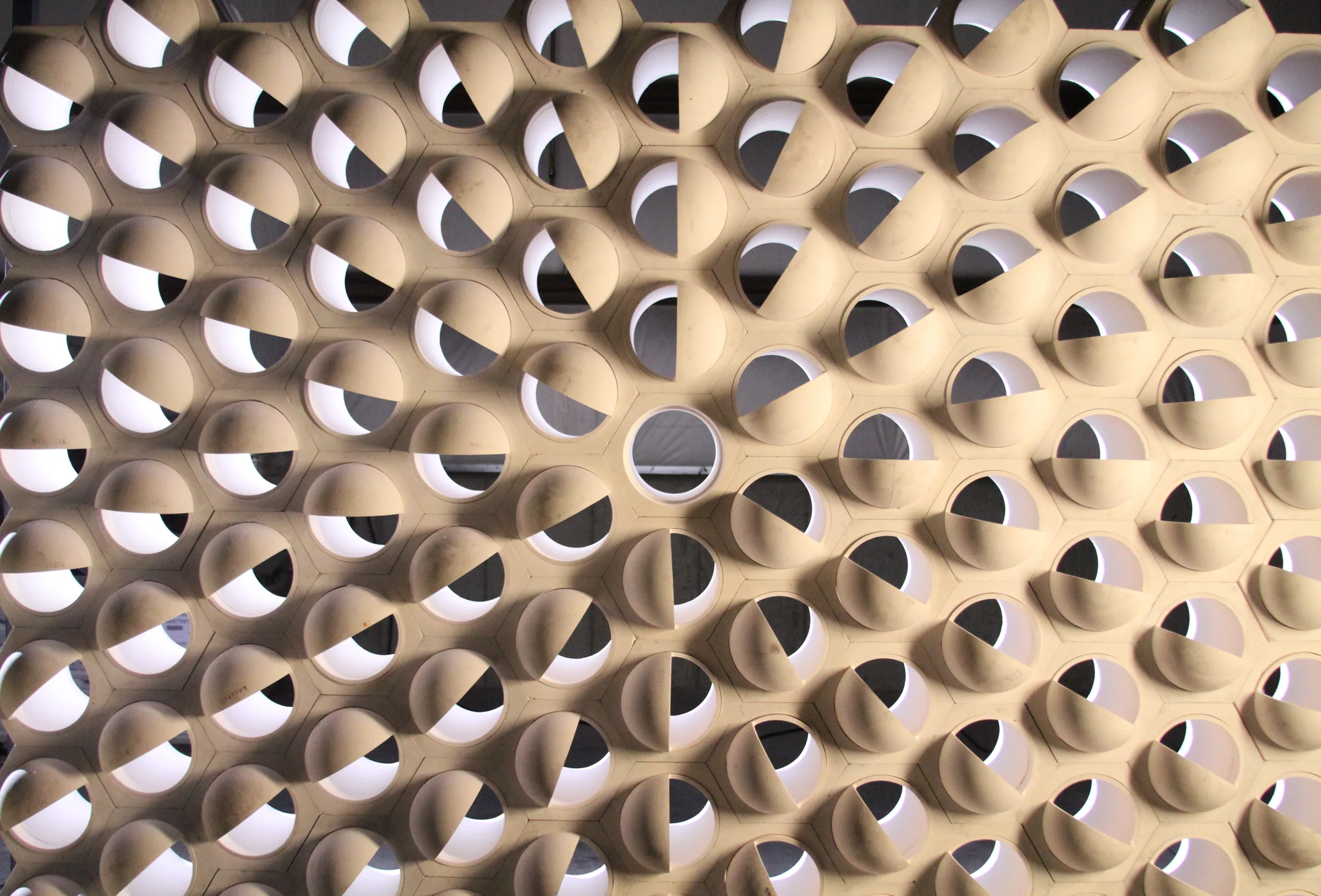
Hexagonal ceramic blocks with angled openings
In short

A gas plant operator in the Middle East found that the brick checker walls in its Claus reaction furnaces had failed again and again for more than 20 years, from thermal cycling, mortar failure and vibration. Its own engineering review recommended an interlocking hexagonal ceramic block wall, and the plant's sulfur recovery unit now runs one of the larger diameter VectorWalls installed to date, as reported in PTQ in 2014.

Hexagonal ceramic blocks with angled openings

What the furnaces ask of a checker wall

The operator's sulfur recovery units use the modified Claus process. Acid gas is preheated to 500 °F (260 °C), combustion air to 700 °F (370 °C), and steam is injected to keep the flame below 2,400 °F (1,315 °C). The furnaces normally run at 1,800 to 2,000 °F (980 to 1,090 °C), but the hot face has to take 2,500 to 3,000 °F (1,370 to 1,650 °C) during start up on natural gas.

The lining is two layers: firebrick at the hot face and an anchored castable behind it. The checker wall sits inside that lining, mixes the gas, holds it for the reaction and shields the boiler tubesheet from radiant heat.

What the review concluded

The walls were not failing because of one bad rebuild but because mortared brick cannot follow the heat cycles of a Claus furnace, so the operator stopped repairing the design and replaced it.

Why the brick walls failed

The existing walls were either cylindrical or built as a matrix of brick boxes jointed with mortar. The operator's heat transfer engineers found:

  • Thermal cycling at start up and shutdown cracked the mortar and the brick
  • Liquid carryover into the combustion chamber loosened the brick system
  • Running the unit above its design capacity caused vibration that the walls could not take
  • Repairs meant repeated failures, short service life, long shutdowns and high repair costs

What was installed

The review recommended an interlocking hexagonal ceramic block system for medium and large diameter reaction chambers. The plant installed a VectorWall: hexagonal blocks with tabs and slots on all sides, stacked without mortar, with vectoring tiles that mix the gas across the whole chamber. For walls over 5 m, Blasch uses 18 inch blocks to keep the wall stable at that size.

What a gas plant gets from mixing

Gas plant SRUs are often very large, and with lean acid gas they need fuel gas co-firing to reach the 1,050 to 1,100 °C that destroys BTEX. A wall that raises front zone temperature lets the plant cut that co-firing. Blasch's published calculation for a typical 500 t/d SRU, with fuel gas at US$3 per million Btu, puts the energy savings at over US$250,000 per year.

Related pages

HexWall checkerwall

The interlocking block wall without vectoring tiles, for walls that mainly need to stand.

HexWall checkerwall

Sulfur recovery units

The thermal stage of the Claus process and its internals. Sulfur recovery

Fuel gas savings in an incinerator

A US operator cut tail gas incinerator fuel gas by almost half with a VectorWall.

Incinerator case
Frequently asked

Questions about this gas plant

Are there operating results from this plant?

The published article covers the failure review and the recommendation. Field results from the larger VectorWall are not part of it.

How large can a VectorWall be?

Walls of more than 5 m diameter are built with 18 inch blocks. This plant's wall is one of the larger diameters installed.

Is the US$250,000 figure from this plant?

No. It is a published calculation for a typical 500 t/d gas plant SRU with lean feed, not a measured value from this unit.

Full checkerwall of hexagonal blocks with angled openings

Rebuilding checker walls
turnaround after turnaround?

Send the furnace diameter, the feed and the history of the current wall. A Blasch engineer works out the block size and layout for your furnace.

Talk to an engineer Call