Case study

VectorWall in a Claus tail gas incinerator:
almost half the fuel gas

A US sulfur recovery operator replaced a failing checker wall and cut incinerator fuel gas by almost 50%.

The checker wall kept failing, and the incinerator burned extra fuel to make up for poor mixing.
One wall of interlocking blocks fixed both

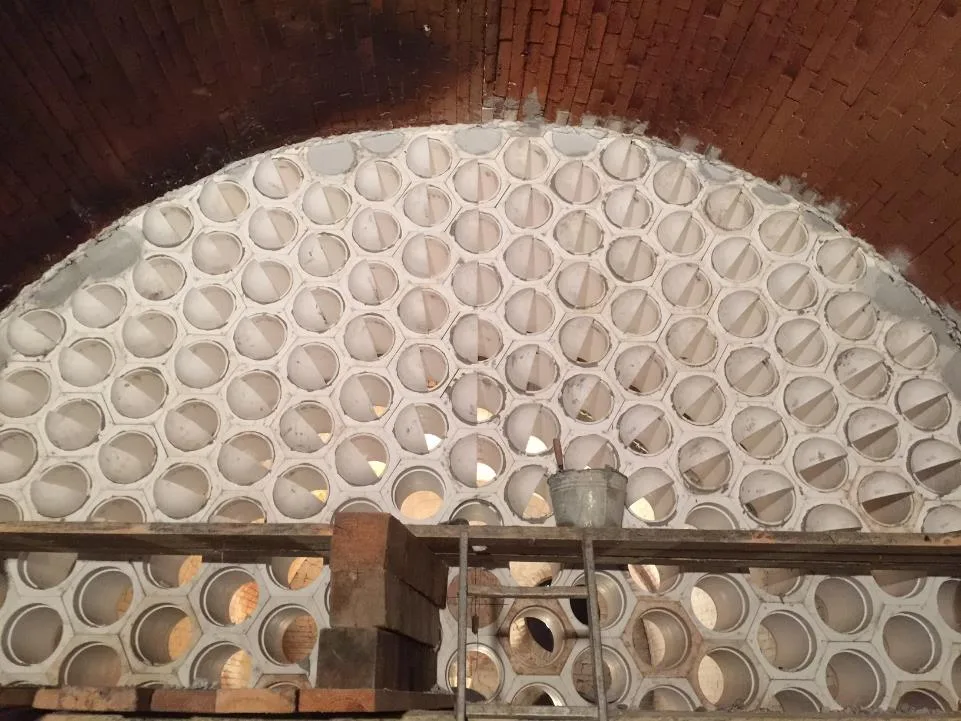
Checkerwall of hexagonal ceramic blocks installed in a furnace
In short

At a Claus sulfur recovery unit in the US Mid-Continent, a VectorWall installed in the tail gas incinerator during the 2009 turnaround cut fuel gas use by almost 50% and excess oxygen by 2%. Sulfur carryover to downstream equipment almost disappeared, and inspections after five years in service showed no cracks in the wall, according to the case published in Hydrocarbon Engineering.

Checkerwall of hexagonal ceramic blocks installed in a furnace

An incinerator fed by swinging refinery gas

The operator runs sulfur recovery over the fence for several refineries. The volume reaching the tail gas incinerator therefore swings with the refineries' gas, from high flow to very low flow.

The incinerator's brick checker wall failed mechanically again and again. Even intact, it did not mix the gas well enough for complete combustion, above all at low flow. The plant saw elemental sulfur leaving the incinerator and settling in downstream equipment, soot during upsets, and a shell running cool enough for acid to condense on it.

To keep combustion complete, operators fired more fuel gas and ran more excess oxygen than the process needed.

What the fuel gas was paying for

In this incinerator the extra fuel gas was not buying temperature, it was buying mixing, and a wall that creates the turbulence itself makes that fuel unnecessary.

What was installed

Blasch hex head ferrules were already in service at the plant's Claus burner and off gas incinerator, so the operator brought the checker wall problem to Blasch as well. Together with the plant's engineers, Blasch designed a VectorWall of interlocking hexagonal blocks. Deflector tiles in the block openings direct the gas into a mixing pattern that raises turbulence in the combustion chamber. The old wall came out and the VectorWall went in during the 2009 turnaround.

Results

Measured value Change after the VectorWall
Fuel gas to the incinerator cut by almost 50%
Excess oxygen for complete combustion cut by 2%
Elemental sulfur carryover almost all eliminated, no more sulfur buildup downstream
Incinerator shell temperature raised above 500 °F, no more sulfuric acid condensation
Condition of the wall no cracks or deterioration after five years

What the operator gets

Lower fuel gas and oxygen cost every hour the incinerator runs, no sulfur cleanup in the downstream equipment, and a shell that no longer corrodes from condensing acid. The wall itself stopped being a repair item at each turnaround.

Related pages

VectorWall mixing checkerwall

Interlocking hexagonal blocks with vectoring tiles for reaction furnaces and incinerators.

VectorWall checkerwall

Tail gas incinerators

Where incinerators lose fuel and how internals change combustion. Tail gas incinerators

VectorWall in a refinery SRU

A reaction furnace revamp in Asia that raised sour water stripper gas throughput.

SRU capacity case
Frequently asked

Questions about this incinerator

Was the incinerator burner changed?

The case describes only the replacement of the checker wall with a VectorWall during the 2009 turnaround.

Why did the shell temperature matter?

Below the dew point of the flue gas, sulfuric acid condenses on the steel shell and corrodes it. With the shell above 500 °F, condensation stopped.

Does a VectorWall need mortar?

No. The hexagonal blocks interlock and are stacked dry, so the wall can grow and shrink with each heat cycle without cracking joints.

Checkerwall of hexagonal ceramic blocks installed in a furnace

Burning fuel gas
to make up for poor mixing?

Send the incinerator dimensions, the gas flow range and the current wall design. A Blasch engineer looks at what a mixing wall can do in your chamber.

Talk to an engineer Call