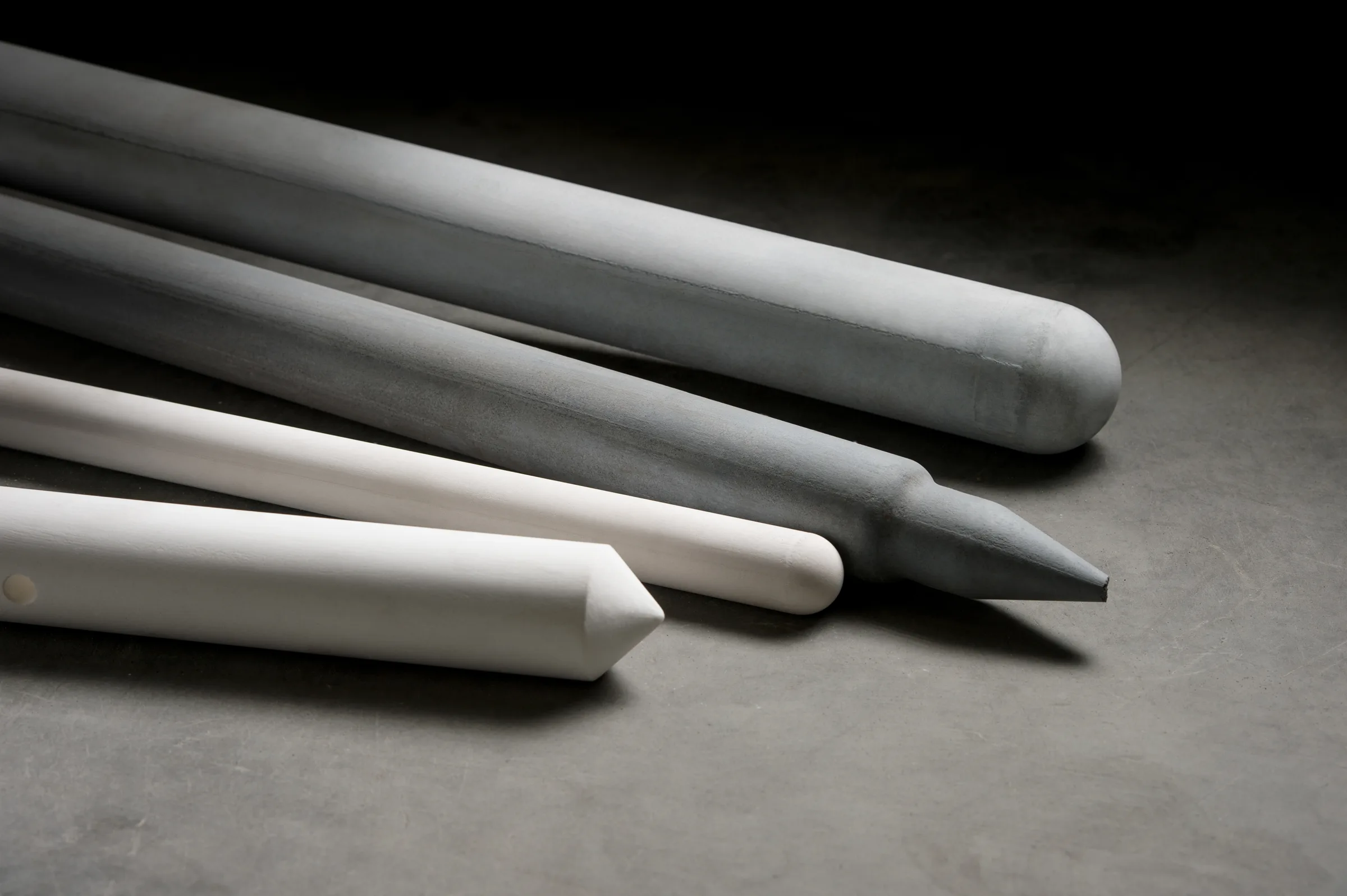
Degassing and die casting

Ceramic pour spouts, down spouts
and metering nozzles for molten metal

Flow control parts for cast houses, atomizing and casting lines, cast to the bore and seat they need.

A nozzle meters metal through one bore.
When that bore erodes, everything downstream changes.

Ceramic nozzles, down spouts and pour spouts
In short

Ceramic pour spouts that last in metal transfer combine three things: a material matched to the alloy, thermal shock resistance for every start, and a bore that is cast to size so it starts accurate and erodes slowly. Blasch makes nozzles, down spouts and pour spouts in OXYTRON and NITRON silicon carbide, fused silica, zirconia, aluminum titanate and alumina, with non-wetting grades that are easy to clean. The inlet is cast to seat a stopper rod for on and off or metering control.

What wears out a nozzle

Every pour starts with a thermal shock, when hot metal hits a nozzle that has cooled. Spalling at the inlet and erosion at the nose then widen the bore, and a wider bore changes flow rate, stream shape and, in atomizing, powder size.

Metal that wets the nozzle sticks and freezes, and the cleaning that follows wears the bore further.

So the life of a spout is decided by its material, by the accuracy of the bore when it is new, and by how slowly that bore grows.

The bore is the product

A metering nozzle is a hole with ceramic around it, and every thousandth of an inch that the hole grows changes how much metal reaches the mold.

Shapes and features cast in ceramic

The Blasch process forms these details in the casting, without machining.

Metering bores

Tightly controlled bores and exits for the flow rate or powder size you need.

Stopper rod seats

Inlet geometry for on and off or metering control with a mating rod.

Anti-vortex inlets

Designs that keep a vortex from drawing slag and air into the stream.

Threads and sharp edges

Cast threads and angles for mounting, and sharp cast edges for fine powder and spraying.

Material for the metal

Material Typical use
OXYTRON, NITRON silicon carbide Aluminum and copper alloys, non-wetting
Aluminum titanate Aluminum, low thermal expansion
Fused silica Thermal shock in intermittent pouring
Zirconia Nickel, cobalt and other high temperature alloys
Alumina General metal transfer and atomizing

Each material is tested in the Blasch lab for modulus of rupture, density, thermal shock, creep deflection, oxidation and wear. For new atomizing systems, FEA checks the stresses at temperature and CFD models the flow from tundish through nozzle and spout. Modeling and testing at Blasch

Where these parts are used

In the cast house for metal transfer, in continuous casting of non-ferrous metals, and in gas atomization, where the nozzle sets the stream that becomes powder. Ceramic atomizing nozzles cover the gas side of that system.

The spout usually sits at the end of a launder or tundish lining.

Degassing and die casting parts

Frequently asked

Questions about pour spouts and nozzles

Can you make a nozzle and stopper rod as a matched pair?

Yes. Nozzle seat and rod nose are cast to fit each other for accurate metering, in bottom pour crucibles and ladles.

Which material should I use for aluminum?

Non-wetting OXYTRON or NITRON silicon carbide, or aluminum titanate. They are easy to clean and resist sticking metal.

Do I need a drawing to order a custom spout?

No. The bore, the mounting and the alloy are enough to start. A Blasch engineer designs the part to fit your current or new casting system.

Ceramic stopper rods and metering pins

Flow rate drifting
as the nozzle wears?

Send the bore, the mounting and the alloy. A Blasch engineer recommends the material and the nozzle geometry.

Talk to an engineer Call