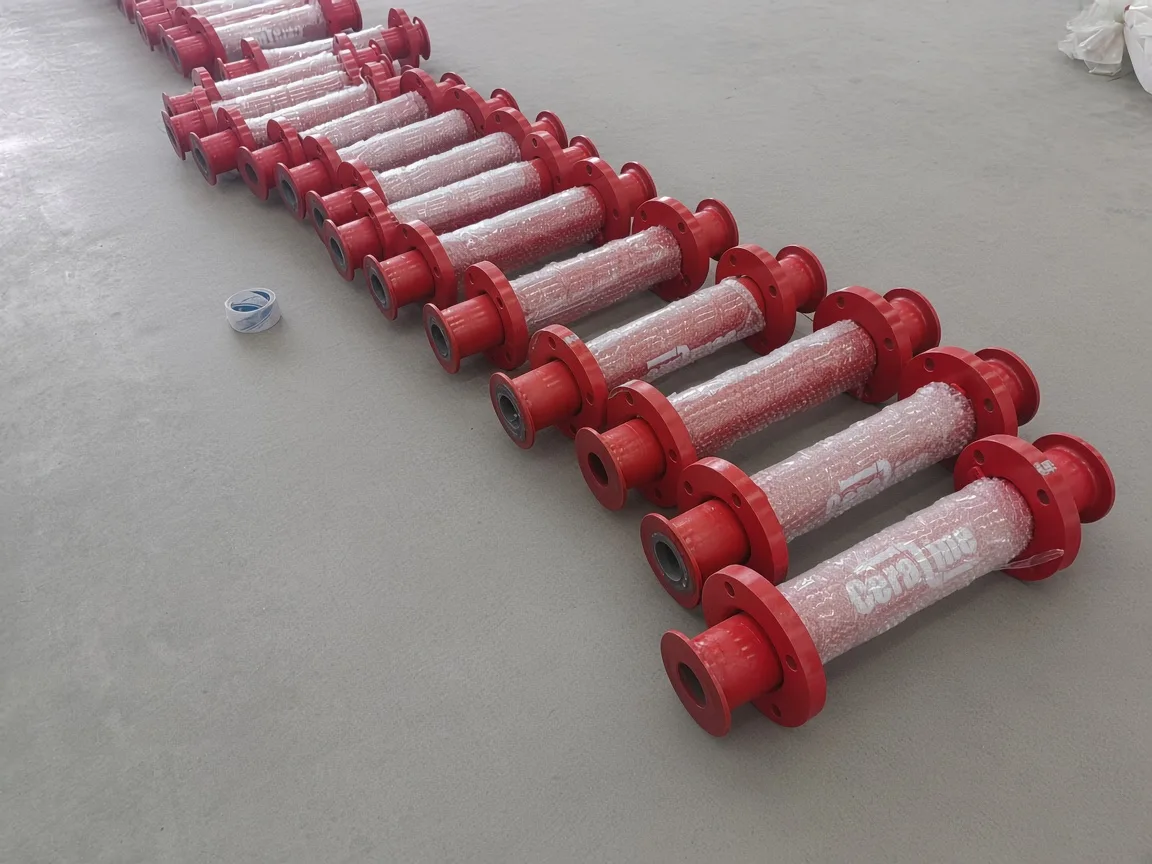
CeraLine spools

Ceramic lined pipe spools:
fitted flange to flange, no field work

Straight CeraLine sections with a one-piece liner, built to the length of the run they replace.

Straight sections with a one-piece ceramic liner, up to 7 ft long.
They arrive ready to bolt into the line.

Large flanged spool with a white ceramic liner, seen from the open end
In short

A ceramic lined spool is fitted like any other spool piece: the worn section comes out, the lined spool goes in, and it is bolted, coupled or welded to the pipe on both sides. CeraLine spools arrive with the ceramic already fired and set inside the steel body, with ends made to your flange standard, coupling or weld preparation. No ceramic work and no curing happen on site.

How a lined spool
goes into the line

The work happens in the shop, so the outage is spent on bolts and gaskets, not on ceramic.

01

Measure the section

Face-to-face length, pipe size, flange standard or coupling, and where the supports sit. A sketch with dimensions is enough.

02

Design the spool

The engineer sets the liner wall, the ceramic grade, the joint between liner sections and the end detail that meets your existing bore.

03

Build and ship

Each liner section is cast and fired in one piece, set into the steel body, and the spool is crated as a finished unit.

04

Install

The old section comes out and the lined spool goes in with the same connection as the piece it replaces.

Ceramic pipe and spool liners of different diameters

End connections that match
the pipe you have

Spools are made with ANSI flanges, Victaulic ends, weld-on or slip-on flanges, threaded ends or plain pipe ends, whichever the line already uses.

Concentric and eccentric reducers connect a lined run to a pipe of another size. Where the lined bore has to stay at the diameter of the existing line, the steel body is upsized and the step is taken up inside the end fitting, not in the flow.

Where two lined spools meet, the ceramic ends carry a shiplap or a tongue and groove, so the gap at the flange does not open a path to the steel.

What the shop saves

A lined spool is finished before the outage starts, so the shutdown lasts as long as it takes to swap a spool, not to build a lining.

Inside the spool

Three details are set for each run. They come from the medium, the velocity and the history of the section being replaced.

Wall thickness

From 1/4 inch to 8 inches, chosen from the wear rate the line has shown so far.

Flow features

Anti-vortexing shapes or an internal spinner can be cast into the liner where the line needs to stop or set a swirl.

Steel body

Carbon steel for most lines, stainless such as 304 with custom flanges where the outside of the spool also needs corrosion resistance.

Spool sizes and
where they run

Spool data Range
Length per spool up to 7 ft
Diameter up to 3 ft
Liner wall 1/4 in to 8 in
Liner joints shiplap, tongue and groove
Ends ANSI flanges, Victaulic, weld on, slip on, threaded, plain
Ceramic silicon carbide grades or dense alumina

Lined spools run in slurry and tailings lines, SAG mill circuits, FCC slurry service, pneumatic conveying between two elbows, and battery material plants. Ceramics for mining and mineral processing

A US Midwest lithium battery plant replaced stainless spools and elbows that lasted months with reaction bonded silicon carbide liners in 304 stainless bodies. They have been in service for more than a year. Lithium battery case

The bends in the same lines are covered on the page for ceramic lined elbows. Why a one-piece liner outlasts tiles and coatings is explained on the page for CeraLine ceramic lined pipe.

Frequently asked

Questions about lined pipe spools

Does a lined spool need curing or dry out after installation?

No. The ceramic is fired in Albany and set into the steel before the spool ships, so the line can start up once the connections are made.

How long can one lined spool be?

Up to 7 ft. Longer runs are built from several spools, with shiplap or tongue and groove liner ends at each joint.

Which ceramic goes into a slurry spool?

That depends on particle size, solids content, velocity and chemistry. Silicon carbide grades and dense alumina are both options, and the choice is made for each line.

Do you need a drawing of the section?

No. The face-to-face length, the pipe size and the end connections are enough. The spool drawing is made by the Blasch engineer.

Red flanged lined spools laid out in a row

Planning the next
slurry line outage?

Send the length, the pipe size and the end connections of the section that wears. A Blasch engineer returns a spool design for that run.

Talk to an engineer Call