Case study

A Claus furnace that shook
at high throughput, and stopped shaking

How replacing a choke ring with a VectorWall removed the vibration that capped a refinery sulfur recovery unit.

Vibration and noise set the limit on throughput, not the burner and not the boiler.
The cause sat in the middle of the furnace

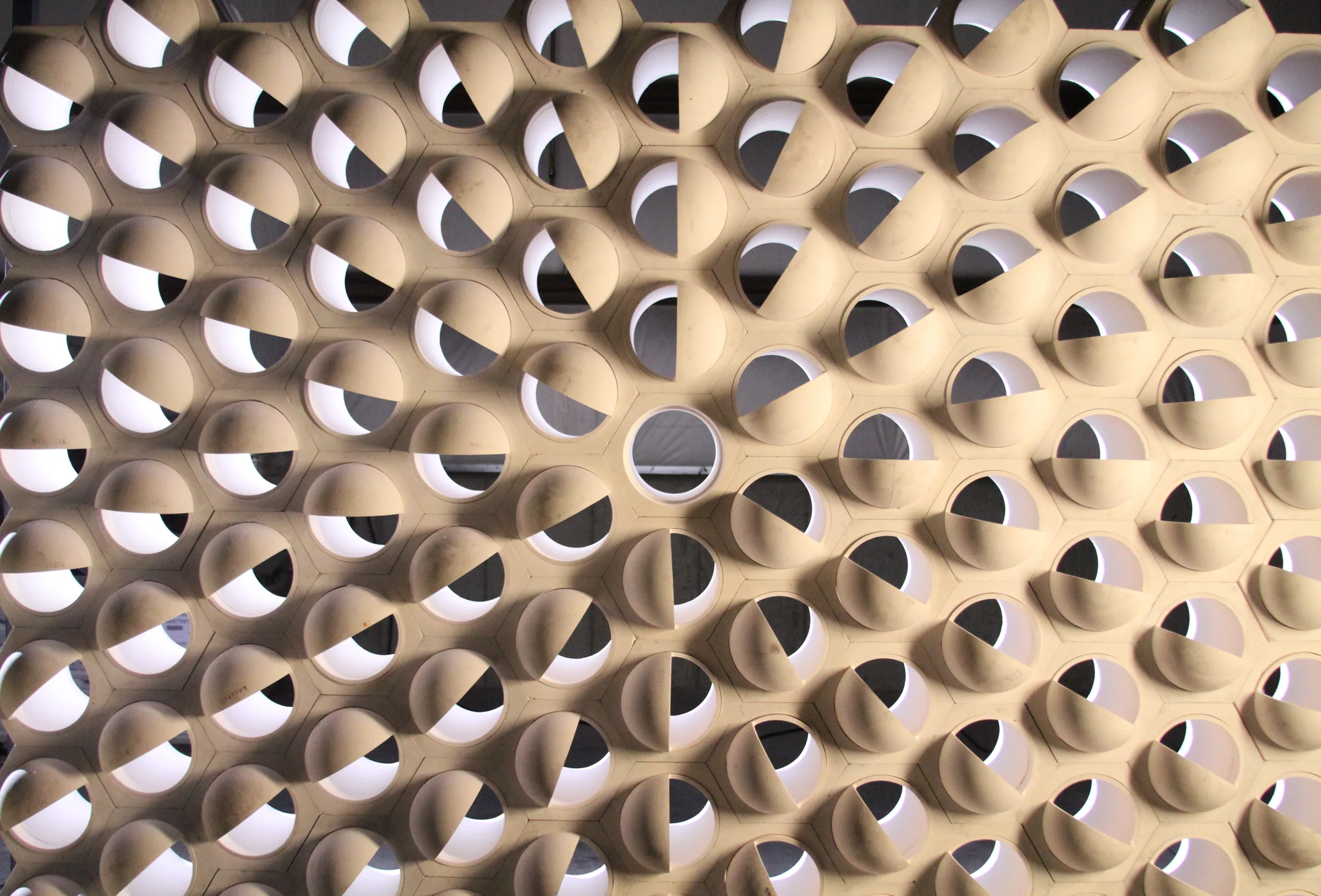
Close view of vectoring tiles in a checkerwall
In short

In the Claus reaction furnace of a refinery sulfur recovery unit in Asia, vibration limited how much acid gas the unit could process while the furnace had a choke ring. After the choke ring was replaced with a VectorWall, the unit ran at higher capacity, destroyed ammonia better, and no more furnace vibration was observed. A later CFD study traced the vibration to how the flame and pressure waves behaved in front of the choke ring.

Close view of vectoring tiles in a checkerwall

What vibration does to a reaction furnace

A Claus reaction furnace converts about two thirds of the sulfur in its thermal stage and destroys ammonia and hydrocarbons in the feed. Internals such as checker walls and choke rings are there to mix the gas and hold it at temperature long enough.

When those internals let the flow jet or pulse, the furnace starts to shake. Operators then hold back throughput to protect the furnace. Brick checker walls loosen and crack under the same vibration, and walls in that state make it worse.

Where the noise came from

The vibration was not a fault of the brick lining but of the flow, so the cure was a wall that shapes the flow instead of one that only stands in its way.

What the CFD study found

An independent engineering firm modeled the furnace with the choke ring and with the VectorWall for Blasch.

  • With the choke ring, pressure waves reflecting off the ring gave the flame an open shape inside the burner can. The flame spread to the refractory of the can, a sign of poor combustion, refractory damage and high noise in service.
  • A strong jet passed straight through the ring. In the model 22.5% of the flow did not reach the residence time at over 1,250 °C needed to destroy ammonia.
  • With the VectorWall, the burner flow and the wall interacted far less, a proper flame jet formed out of the burner can, and all of the zone 1 gas met the residence time.
  • Pressure drop through the VectorWall configuration was about 900 Pa lower.

What was installed

A VectorWall in place of the choke ring: interlocking hexagonal blocks, stacked without mortar, with vectoring tiles that turn the flow into a swirl with a long path and a narrow residence time distribution. The tiles also reflect radiant heat back into zone 1.

Results in the plant

Before, with choke ring After, with VectorWall
capacity limited by vibration higher acid gas throughput
ammonium salts in downstream equipment better ammonia destruction
furnace vibration no vibration observed

What the operator gets

The furnace no longer sets its own limit, and the throughput that was held back for vibration is available again. The wall itself has no mortar joints for vibration to work loose.

Related pages

VectorWall mixing checkerwall

Hexagonal blocks with vectoring tiles that shape the flow in reaction furnaces.

VectorWall

Sulfur recovery units

The Claus process and the parts that decide how the thermal stage runs. Sulfur recovery

More throughput in an Asian refinery

Temperatures and sour water stripper gas rates before and after a VectorWall revamp.

SRU capacity case
Frequently asked

Questions about furnace vibration

Is vibration in a Claus furnace always caused by the checker wall?

No. In this unit the CFD study linked it to the flame and pressure waves in front of the choke ring. Damaged brick walls can add to it.

Does the VectorWall raise pressure drop?

In this furnace it lowered it, by about 900 Pa compared with the choke ring.

Can a VectorWall replace a choke ring in an existing furnace?

Yes. It is built into a slot in the lining or against the hot face, with a course of brick on each side, in the position of the old internal.

Full checkerwall of hexagonal blocks with angled openings

Holding back throughput
because the furnace shakes?

Send the furnace dimensions, the current internals and the feed composition. A Blasch engineer looks at the flow and at what a mixing wall could change.

Talk to an engineer Call