Case study

Segmented crucible linings:
heats per campaign in four induction furnaces

Four melt shops compared a precast, segmented crucible lining with rammed, brick and monolithic linings, heat by heat.

Nickel superalloys, vacuum melting, thermal spray powders and aluminum composites.
Four furnaces, one lining principle, counted in heats

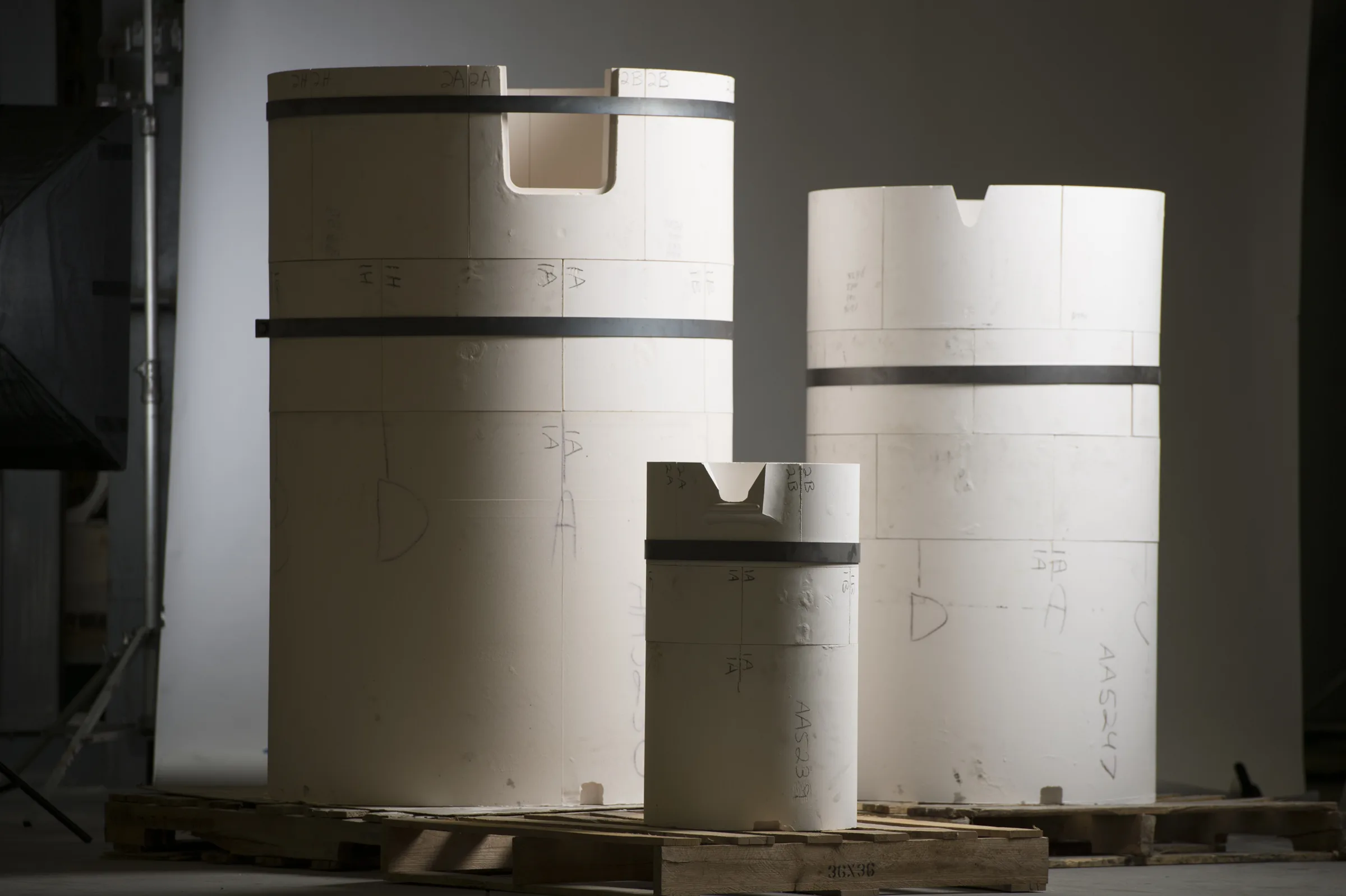
Segmented crucible lining sections
In short

In four coreless induction furnaces from 1,500 lb to 12,000 lb, a precast, segmented crucible lining from Blasch ran more heats per campaign than the lining each melt shop used before: about 50% more than a rammed lining and than magnesia brick in nickel alloy furnaces, about twice as many as a rammed lining on aluminum composites, and five times as many as a monolithic crucible at up to 1,780 °C. Blasch documented the four cases in its case histories under the name Modular Lining System.

Segmented crucible lining sections

Why large induction linings fail early

From about 500 kg of melt upward, thermal stress rather than wear decides how long a crucible lining lasts. A 3 ton alumina or magnesia lining can grow up to 7 mm in height as it heats. A rammed or monolithic lining has to absorb that growth inside one body, and it cracks.

The cracks let metal and slag in, the lining erodes at the melt line, and the furnace is relined before the refractory is worn out. Brick linings bring mortar joints that erode and leak.

The lining that is allowed to crack

A segmented lining is cracked on purpose, at joints that were designed to open and close, so the heat cycles that destroy a rammed crucible have nowhere left to break it.

What was installed

A crucible lining built from precast, fired tongue and groove segments, set without mortar, with gaps that take up the thermal growth. A finite element comparison in Blasch's 2016 white paper shows clearly lower stresses for a segmented lining with expansion gaps than for rammed or mortared linings. A spring loaded hold down system keeps the stack in place.

Results in four furnaces

Furnace and alloy Lining before Heats before, typical Heats with the segmented lining, typical Payback
12,000 lb, nickel alloys 625, 713, 718, pour at 1,590 to 1,700 °C rammed 18 to 20 25 to 30 about 15 heats
6,000 lb, nickel and cobalt alloys in vacuum, 1,590 to 1,700 °C magnesia brick 18 to 20 30 to 35 25 to 35 heats
2,000 lb, Ni, Co, Cr, Al and Y alloys for thermal spray powder, 1,670 to 1,780 °C monolithic crucible 3 to 5 20 to 25 about 10 heats
1,500 lb, aluminum metal matrix composites with up to 20% SiC or alumina, 770 °C rammed 75 150 75 to 100 heats

What else changed

  • 12,000 lb furnace: 50% less rework because inclusions from lining erosion stopped, and 5% more capacity because the segmented lining has less taper near the bottom.
  • 6,000 lb vacuum furnace: magnesia brick had released magnesium into the melt and needed twice the installation time. The plant shuts down over weekends, and the segmented lining could cycle cold, where brick had to be kept hot.
  • 2,000 lb furnace: installation took 30 to 40% longer than a monolithic crucible, which the five times longer life paid back.
  • 1,500 lb aluminum furnace: the lining material cost about twice as much as the ram, and ground faults at the trunnion stopped.

Related pages

InterLok segmented crucible lining

Blasch's tongue and groove crucible lining for coreless induction furnaces in air or vacuum.

InterLok lining system

Vacuum induction melting

Crucibles and linings for nickel and cobalt superalloys melted in vacuum. Vacuum induction melting

Molten metals

Crucibles, linings and flow control for foundries and melt shops.

Ceramics for molten metals
Frequently asked

Questions about these case histories

Why do the heat counts vary so much between furnaces?

Alloy, temperature and how many pours run at the top of the range all change lining life. Yttrium in particular is aggressive and builds slag.

Is a segmented lining more expensive?

The material can cost more, about twice a rammed lining in the aluminum furnace. Each shop calculated its own payback, between about 10 and 100 heats.

Does a segmented lining tolerate a cold shutdown?

In the 6,000 lb vacuum furnace it did: the lining was cycled over weekends, while the magnesia brick before it had to be kept hot.

Are these four cases from one plant?

No. They come from four melt shops with different alloys and furnace sizes.

Segmented crucible lining sections

Relining before the refractory
is worn out?

Send the furnace capacity, the alloys and how many heats a lining lasts today. A Blasch engineer sizes a segmented lining for your coil.

Talk to an engineer Call