Technical Library

Unique furnace challenges
and highly customized baffle designs

A MECS article in Sulphur magazine on replacing a conventional baffle wall with a VectorWall in a sulfuric acid plant.

Every sulfur burning furnace is a little different.
The baffle wall can be designed for yours.

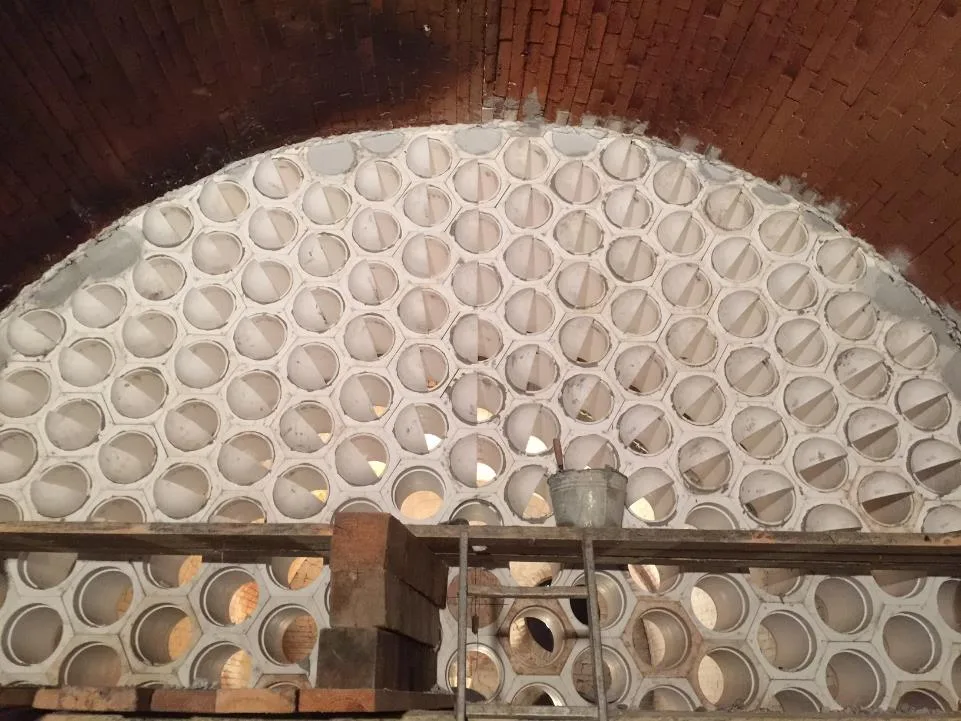
Checkerwall with angled openings for a sulfur recovery furnace
In short

In this Sulphur magazine article, two MECS engineers describe the operating advantages a sulfuric acid plant gained by replacing a conventional brick baffle wall with a VectorWall. The wall is built from interlocking ceramic blocks, and tiles in its openings shape the flow to fit the furnace. The context is sulfur burning furnace optimization, where mixing, residence time and pressure drop decide how completely the sulfur burns.

About this paper

  • Publication: Sulphur magazine, January/February 2016
  • Authors: Brian Lamb and Rick Ullrich, MECS
  • Topic: VectorWall in place of a conventional baffle wall in a sulfuric acid plant
  • Full text: available on request; the full article was not available to us, so this page combines the published summary with other published Blasch and MECS data

A wall that shapes the flow

A brick baffle wall only blocks the gas, while a wall with angled tiles in each opening can tell it where to go.

Close view of angled ceramic tiles in the openings of a checkerwall

What goes wrong in a sulfur burning furnace

Sulfur and air must burn completely before the gas reaches the waste heat boiler. Brick baffle walls leave dead zones and a broad residence time distribution: part of the gas passes quickly, part circulates. Unburned sulfur can then carry over into the boiler, which operators call fireflies.

Brick and mortar baffles also crack under thermal cycling and are rebuilt regularly. Their stability depends on the skill of the crew that built them.

What a VectorWall changes

The VectorWall mixing checkerwall is built from hexagonal blocks stacked without mortar and locked on all six faces. Each opening can carry a vector tile, and together the tiles set up a swirl that uses the furnace volume and narrows the residence time distribution.

MECS published CFD comparisons of three brick baffle walls against one VectorWall in a sulfur burning furnace: the single wall gave lower pressure drop and a narrower residence time distribution. Those results are summarized under the MECS Sulphur 2015 paper. A later article on sulfur burning furnaces adds that newer tile designs shield the boiler from more of the radiant heat than the first generation did.

Why customized

No two furnaces share diameter, burner, feed and number of walls. The wall layout, the share of open and blocked blocks and the tile directions are set for each furnace, usually with modeling by the licensor. The blocks themselves are standard parts, which keeps delivery short.

What this means for your acid plant

If a baffle wall is rebuilt at every turnaround or sulfur reaches your boiler, the wall is worth a design review. Plain interlocking walls without tiles are described on HexWall checkerwall, and the wider picture for acid producers on refining and chemical processing.

Frequently asked

Questions about this paper

Who sells VectorWall for sulfuric acid plants?

MECS offers it for sulfuric acid and spent acid service as MECS VectorWall, made by Blasch.

Can a VectorWall replace more than one baffle wall?

In the sulfur burning furnace MECS modeled, one VectorWall replaced three brick baffle walls with lower pressure drop.

Are the blocks custom made for each furnace?

The blocks are standard sizes. What is customized is the layout, the open area and the direction of the tiles.

Checkerwall with angled openings installed in a furnace

Sulfur reaching
your waste heat boiler?

Tell us the furnace diameter, the number of baffle walls and what you see at the boiler inlet. A Blasch engineer works out a wall layout with your licensor.

Talk to an engineer Call