Technical library

Effect of SMR tunnels on flue gas flow:
a furnace with one tunnel missing

A summary of the 2019 Nitrogen+Syngas CFD study on what happens when an outer tunnel is not rebuilt.

Same furnace, same burners, one tunnel less.
What the flow field does when the outer tunnel is gone.

Two precast tunnel walls standing on the floor of a reformer furnace
In short

Flue gas tunnels shape the whole flow field of a top-fired steam methane reformer, not just the floor. The 2019 Nitrogen+Syngas CFD study by Blasch compared a modeled furnace with all eight tunnels against the same furnace without its outer tunnel. Without it, part of the flue gas left the furnace very quickly while another part recirculated, residence times spread widely, and the average furnace temperature in the model dropped from 956 °C to 916 °C.

About this article

Publication Nitrogen+Syngas, issue 360, July and August 2019
Title Effect of SMR tunnels on flue gas flow
Authors Blasch Precision Ceramics, no individual author named
Topic Computational fluid dynamics of a reformer operated without one flue gas tunnel

The question behind the study

It is widely accepted that a reformer without tunnels loses efficiency. The study asks a narrower question that plants actually face: a tunnel collapsed during the campaign, the debris was cleared at an outage, and the rebuild was pushed to a later turnaround. What does the furnace do in the meantime?

How the model was built

The modeled furnace is 13 m high, 16 m wide and 16 m long, with eight tunnels on the floor, each 16 m long, 1.8 m high and 66 cm wide inside. Ninety six burners heat 336 catalyst tubes.

A variable mesh kept the run size manageable, with a symmetry plane between tunnels 4 and 5 and a finer mesh around the outer tunnel. The tubes were treated as heat sinks without the reforming reaction inside them, so absolute temperatures are comparative only.

To measure residence time, single particles were released at the 12 burners above the outer tunnel, hundreds of times, and their travel time to the exit was plotted as a histogram.

The missing tunnel pulls

Take away one outer tunnel and the flue gas above it stops flowing straight down: the first burners send it to the exit, the last ones send it round in circles.

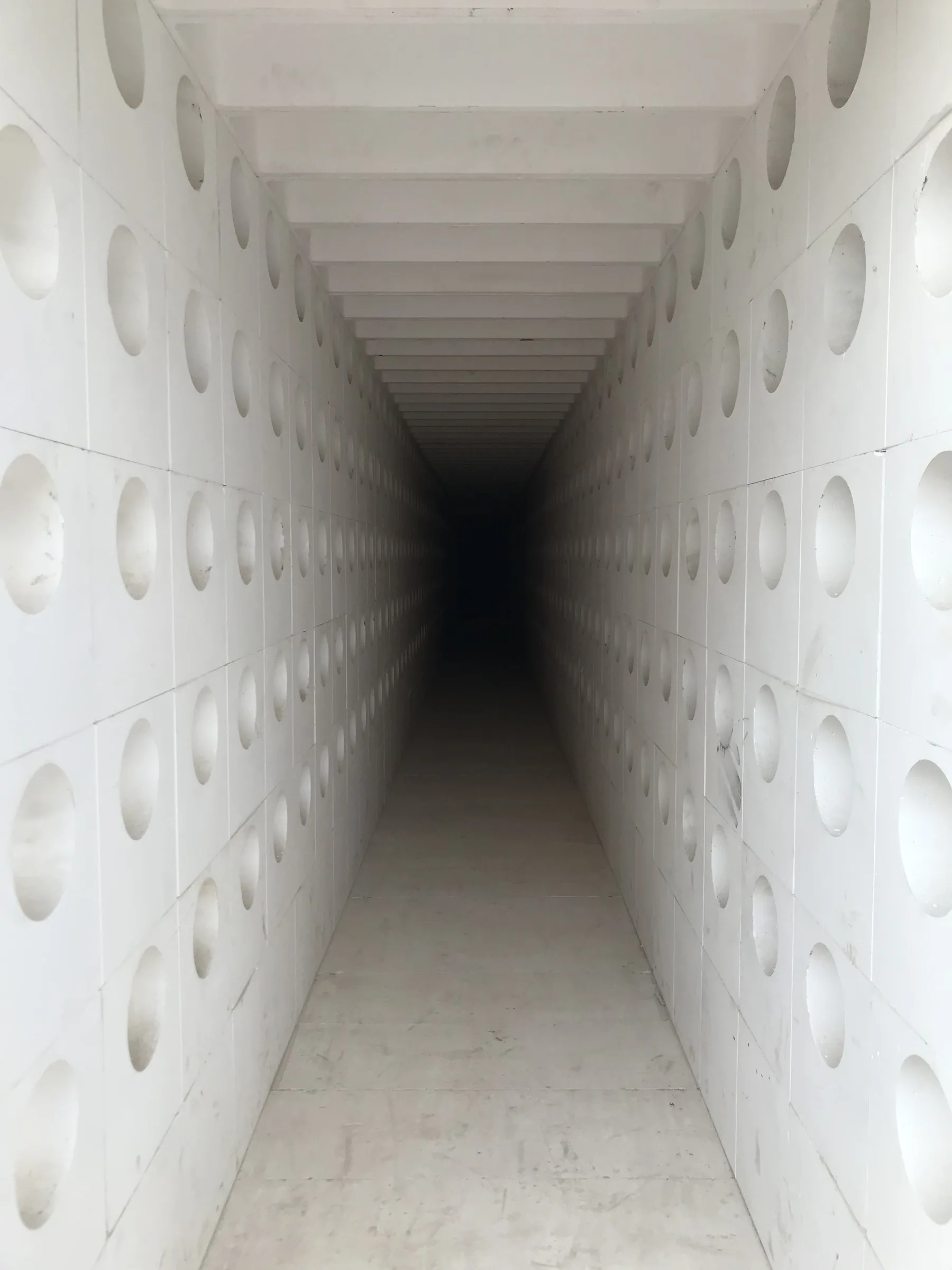
Inside a finished precast flue gas tunnel with rows of round side openings

What the model showed

With all tunnels: the flow covered the whole furnace as designed, but even this control case had some recirculation. The authors note it could gain from balancing burners and tunnel ports.

Without the outer tunnel: the first two burner banks biased their flow toward the exit, and the third bank's gas recirculated. Flue gas leaving through the outer opening came from neighboring burners as well, not only from the outer row. The residence time histogram widened clearly.

Temperatures in the model: 956 °C on average with all tunnels, 916 °C without the outer tunnel, and 836 °C in the area where the outer tunnel would stand.

Gas composition: under stated simplifying assumptions, the lower temperatures translate into up to 9.7% less hydrogen next to the missing tunnel and 0.95% less across the furnace. The cost of that loss over a year is worked out in the white paper version of the study.

Limits the authors name

The reaction in the tubes is not modeled, flue gas temperature is used as a stand in for process gas temperature, and the roof region is assumed equal in both cases. The authors call these reaching assumptions and suggest more analysis for an exact figure. Read the results as a comparison between two furnaces, not as a forecast for yours.

What it means for your reformer

A missing or collapsed tunnel is not a local defect at the floor. It changes where flue gas goes in the upper furnace too. If you are deciding whether to run until the next turnaround, the study is a reason to price the waiting.

A single tunnel can be rebuilt on its own with StaBlox compromised tunnel replacement. The design for a full set is on the StaBlox flue gas tunnel system page.

Frequently asked

Questions about this study

Was a real reformer measured?

No. The study models a theoretical furnace with eight tunnels, 96 burners and 336 tubes and compares two versions of it.

Why does residence time matter?

Heat transfer to the tubes depends on time. A wide spread means part of the flue gas leaves before it has given up its heat, while other gas circulates.

Are the temperatures exact?

No. The tubes are modeled as heat sinks without reaction, so the authors treat the temperatures as comparative only.

Does the study say a furnace without a tunnel is unsafe?

It does not assess safety. It looks at flow, residence time, temperature and the resulting hydrogen yield.

View along the top of a precast tunnel wall

Running with a damaged
tunnel today?

Tell us which tunnel failed and when your next outage is. A Blasch engineer can tell you what a single tunnel rebuild involves.

Talk to an engineer Call